

A repeated sound or phrase can give you something to return to during a quiet pause. You may approach it as a religious practice, a personal reminder or a way to focus your attention. Choose an approach that fits your beliefs and feels comfortable to try.
You do not need to find a perfect phrase, force a positive feeling or expect repetition to bring a particular event into your life. A useful starting point is simpler: decide what the words mean to you, try them briefly and notice whether the practice supports the moment you are in.
On this page
Understand the context
In religious settings, a mantra can be a sacred sequence of sounds or syllables used in meditation, prayer or ritual. The Pluralism Project’s introduction to mantras describes their importance in Hindu, Buddhist and Jain traditions. Their meanings and uses deserve attention beyond a promise of confidence or success.
Everyday self-help writing also uses “mantra” for a personal motto or repeated reminder. A phrase you choose for yourself can be useful to you without being the same practice as a sacred recitation within a particular tradition.
For example, the Pluralism Project describes Om, also written Aum, as a sacred syllable. If you want to learn a traditional mantra, seek its context and pronunciation from a knowledgeable teacher or community connected with that tradition.

Choose words that fit
Start with your purpose for the pause. Do you want to slow down before replying to a message, remember a boundary or make a difficult task feel more approachable? A phrase connected to that purpose may be easier to use than a statement that promises a transformed life.
Choose words you can say without arguing with yourself. If “I am completely confident” feels untrue, you could try “I can ask one question” or “I can take this one step at a time.” You are allowed to acknowledge uncertainty.
You might use one of these ordinary reminders, or write your own:
- “Pause, then choose.”
- “One thing at a time.”
- “My needs can be part of this decision.”
Religious language is optional. If a sacred phrase is part of your own practice, you can follow the guidance of that tradition. If it is unfamiliar or does not fit your beliefs, an everyday phrase, a quiet sound or another point of attention is available.
Try a comfortable practice
Choose a comfortable place to sit or stand, and a brief amount of time you want to try. You can begin with a minute or two rather than making a demanding daily commitment. Keep your breathing natural; there is no need to hold it or coordinate it with a fixed count.
Repeat the phrase quietly, aloud or in your mind, at an easy pace. You can keep your eyes open. Leave a little space between repetitions instead of trying to make the words overpower every other thought.
When your attention wanders, notice it and decide whether to return to the phrase. A distracted session does not show that you lack commitment or that you have chosen the wrong words. You can shorten the practice, change the phrase or stop.
Connect words with action
After the pause, choose one action that fits the reminder. “One thing at a time” could lead to opening the document you have been avoiding. “My needs can be part of this decision” might help you prepare a question before agreeing to another responsibility.
If manifestation language is meaningful to you, you can use a phrase to express an intention. Repeating it does not establish control over another person’s feelings, a health outcome or an event outside your influence. Disappointment is not proof that you failed to believe strongly enough.
Keep practical support in the picture. A phrase about rest can accompany making time to rest; it cannot create more hours in an overloaded day by itself. Ask what help, resources or change in expectations would make the next step more workable.
Review what is useful
Ask whether the practice helped you pause or choose an action, rather than whether you felt peaceful enough. You can keep a phrase, revise it or set it aside. There is no need to turn repetition into another standard you must meet every day.
If a meditation practice increases distress, stop and consider another activity or support. The National Center for Complementary and Integrative Health’s guidance on meditation and mindfulness discusses uncertain benefits and possible negative experiences, and advises against replacing needed health care with meditation. A brief personal practice can sit alongside the care you already use.
Read the infographic in text
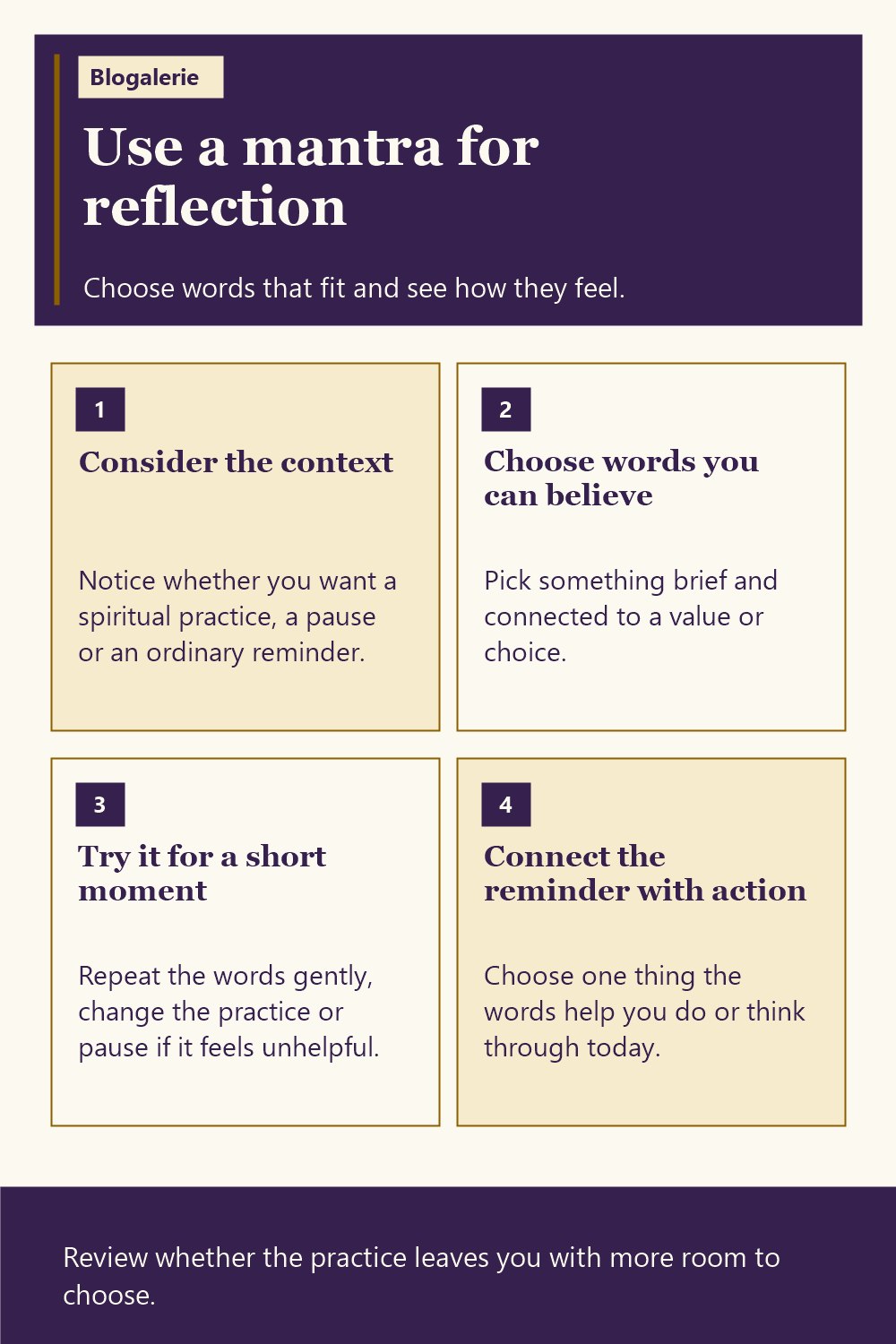
Use a mantra for reflection Choose words that fit and see how they feel.
- Consider the context Notice whether you want a spiritual practice, a pause or an ordinary reminder.
- Choose words you can believe Pick something brief and connected to a value or choice.
- Try it for a short moment Repeat the words gently, change the practice or pause if it feels unhelpful.
- Connect the reminder with action Choose one thing the words help you do or think through today.
Review whether the practice leaves you with more room to choose.
The article presents a comprehensive overview of mantras and their significance in meditation. I appreciate the emphasis on the diverse meanings behind each mantra, which encourages individuals to explore their spiritual paths more deeply. The relationship one forms with a mantra can indeed serve as a catalyst for personal growth. However, I would be interested to know more about the psychological implications of using mantras and how they might affect cognitive processes during meditation. Are there any studies that link mantra repetition with measurable changes in brain activity or emotional well-being?
‘Om’ as a universal sound reflects profound philosophical underpinnings found across numerous cultures; its inclusion highlights its significance not only as a mantra but as an element of cultural identity in spiritual practices worldwide. While you touch upon its importance, exploring other cross-cultural perspectives on similar sounds could enhance our understanding further. How do practitioners from different traditions utilize their respective chants or sounds? Lastly, considering modern adaptations—such as digital applications promoting mindfulness—might present new avenues for traditional practices like mantra usage.
This article adeptly highlights the intersection between mindfulness and spirituality through the use of mantras. The connection drawn between sound and consciousness is particularly noteworthy; it invites readers to contemplate their personal experiences with sound in various contexts beyond meditation. However, I believe further exploration into the scientific foundations behind binaural beats would enrich this discourse. How do these auditory stimuli affect our neurological states during meditative practices? Understanding this could provide deeper insights into why some individuals may find certain mantras more effective than others.
‘So Hum’ serves as a remarkable reminder of self-identity amid external chaos—a central theme deserving greater exploration within contemporary contexts where many grapple with self-worth issues exacerbated by societal pressures. This perspective raises questions about integrating these ancient principles effectively into modern life: How can individuals maintain authenticity while navigating external expectations? Offering guidance around aligning personal values with chosen affirmations may empower readers seeking clarity along their meditative journeys.
The exploration of various mantras presented here provides an excellent foundation for understanding their roles within meditation practices. Particularly interesting is the concept of personalizing one’s mantra based on individual needs; this suggests a dynamic approach to spirituality that evolves over time. That said, I am curious about potential pitfalls associated with changing mantras too frequently—could this lead to inconsistency in practice or hinder deeper connection? Additionally, what role does community play in shaping one’s understanding and use of these sacred phrases?
I found this article quite insightful in illustrating how mantras can elevate one’s meditation experience. The various examples provided offer a clear guide for those unfamiliar with this practice. However, I wonder about the subjective nature of ‘finding the right mantra.’ What criteria should one consider when selecting a mantra? Is it purely intuitive, or could external factors play a significant role? Furthermore, it might be valuable to delve into how societal expectations influence individual choices when engaging in spiritual practices such as these.
This piece succinctly outlines the role of mantras in enhancing meditation practices. The selection of mantras presented is both intriguing and varied, catering to different emotional and spiritual needs. It raises an interesting question regarding the universality of these practices across cultures—how do different societies interpret and implement mantras? Moreover, it would be beneficial to consider potential challenges faced by beginners when integrating these concepts into their routines. Are there particular strategies that can help mitigate confusion or frustration during initial attempts at meditation with mantras?
‘Om Shanti’ resonates deeply within many spiritual circles due to its emphasis on peace—a concept increasingly vital in today’s fast-paced world. The idea that chanting can transcend mere words is compelling; however, what mechanisms enable such transformations? An examination into how specific frequencies or rhythms contribute to emotional states could provide fascinating insights for practitioners seeking deeper levels of tranquility through sound vibrations during meditation sessions.