

Working toward a goal does not require feeling certain that you will succeed. You can be hopeful, doubtful or nervous and still gather information, prepare and try something manageable. Confidence is one part of the experience; it does not control every result.
Choose a goal you are considering now. Instead of asking whether you believe in it strongly enough, ask what you need to know before your next decision. That question can lead to a plan you can adjust.
On this page
Name the uncertainty
Write the concern as specifically as you can. “I will never manage this” is a broad prediction. “I do not know whether I can attend the evening sessions” identifies a question you can investigate.
Separate what is unknown from what is already difficult. A timetable, a fee or a missing qualification may need practical information. Fear of being judged may call for a smaller first attempt or a conversation with someone who understands. Neither needs to be dismissed as a bad attitude.
Check a prediction against available information
Ask what supports your concern, what points in another direction and what you still do not know. Look for a balanced account you can believe, rather than replacing every worry with a promise of success.
For example, “I found this difficult before, and a shorter introductory session could help me judge whether to try again” leaves room for both experience and possibility. It is more useful than insisting that failure cannot happen.
The NHS guide to reframing unhelpful thoughts suggests examining evidence and considering a neutral or more positive alternative. It also recognises that you may not be able to change every thought.
| Thought and question | Possible next step |
|---|---|
| “I failed once.” What was difficult then? |
Change one condition before another attempt. |
| “I lack the time.” What does the first step require? |
Try a smaller commitment or postpone it. |
| “Everyone will judge me.” Whose feedback matters for this task? |
Ask one suitable person a specific question. |

Prepare an attempt that gives you information
Choose a step with a clear limit. You might ask about a course, draft one paragraph or practise one part of a skill. Decide what you want to learn from doing it.
If the goal involves a substantial commitment, an exploratory step should leave room to decline. Reading the terms, asking about access or seeing an example does not require paying for a full programme.
Prepare what you need, including time and a suitable setting. If you cannot make room now, record the question or choose a later review date. A delay can reflect real circumstances.
Use encouragement alongside honest feedback
Look for support that combines care with useful information. A person can encourage you while pointing out a cost, a risk or a skill you still need. Disagreement is not automatically negativity.
Ask for feedback about something specific: “Is this explanation clear?” or “What would I need before applying?” Then decide which suggestions are relevant and which depend on a different goal or preference.
You can also set a boundary around comments that are insulting or repeatedly discouraging. You do not have to accept disrespect in order to learn from other people.
Let a setback guide a practical adjustment
After an attempt, describe what happened without turning it into a permanent label. Did you run out of time, misunderstand a requirement or discover that you disliked the activity? Different difficulties call for different responses.
Choose one adjustment if another attempt seems worthwhile. That could mean more preparation, a different method, help with a task or a smaller goal. Repeating the same approach indefinitely is not the only form of persistence.
If imagining the outcome helps you remember why the goal matters, use that image as a reminder. Pair it with a practical next action and a check of the conditions around it.
Review whether the goal still fits
At a useful stopping point, consider the effort, cost, interest and effect on the rest of your life. Ask whether you want to continue, change the pace, seek support or choose another direction.
You can care about a goal and decide that its current demands are too high. Changing your plan does not require pretending the original wish never mattered.
If worry is persistent, distressing or affecting daily life, consider support from a healthcare professional. You can seek help with how you feel while also making practical decisions about your goal.
For your next step, name one uncertainty, one way to check it and one limited action. A workable plan can leave room for doubt, learning and a change of mind.
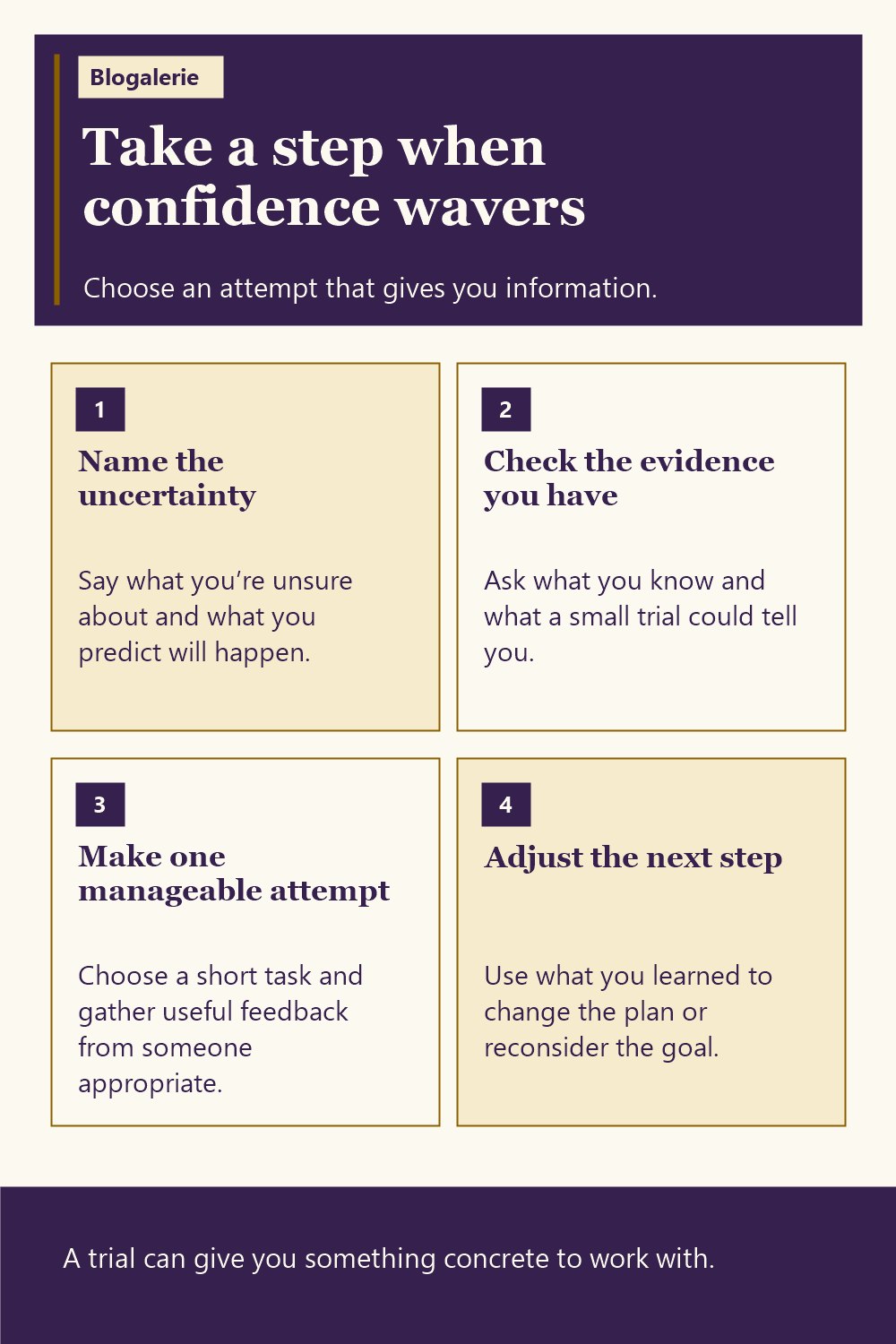
Read the infographic in text
Take a step when confidence wavers Choose an attempt that gives you information.
- Name the uncertainty Say what you’re unsure about and what you predict will happen.
- Check the evidence you have Ask what you know and what a small trial could tell you.
- Make one manageable attempt Choose a short task and gather useful feedback from someone appropriate.
- Adjust the next step Use what you learned to change the plan or reconsider the goal.
A trial can give you something concrete to work with.
‘Mindset’ has become somewhat of a buzzword in self-help circles; however, articles like this serve as useful reminders of its genuine importance in achieving objectives in life. The call for banishing negativity struck me as especially pertinent given today’s societal pressures manifesting through social media—where comparison often breeds discontentment rather than inspiration.
The exploration of mindset as a crucial factor for success resonates strongly within contemporary psychological discourse. Particularly notable is the assertion that one’s perception directly influences action-oriented behavior—a notion firmly supported by behavioral psychology principles. However, one must question whether there are inherent limits imposed by socio-economic factors or mental health issues that could impede this idealistic approach toward success through mere mental adjustments alone? A multifaceted approach recognizing both internal beliefs and external realities might offer a more comprehensive understanding of achieving personal goals.
‘AnalyticalNerd’ raises an important point regarding socio-economic factors affecting mindset formation and success trajectories. While cultivating a positive outlook is undoubtedly beneficial, it’s crucial not to overlook systemic barriers that many face daily which might inhibit their ability to believe in themselves or their potential for success.
This discussion on mindset offers profound insights into personal development strategies. The emphasis on affirmations as tools for shifting thought patterns aligns well with cognitive behavioral theories which suggest that changing thought processes can lead to altered behaviors and emotions over time. It would be beneficial if the article elaborated further on specific examples or case studies where individuals successfully transformed their mindsets and consequently achieved their goals—perhaps drawing from diverse backgrounds or experiences to illustrate this point more vividly.
The article presents a compelling argument for the significance of mindset in achieving personal goals. The concept of the ‘growth mindset’ versus the ‘fixed mindset’ is particularly noteworthy. It emphasizes how our self-talk and internal dialogue can either empower or hinder us in our pursuits. Additionally, the mention of the placebo effect provides a fascinating perspective on how belief can influence outcomes, not only in health but also in personal development. I find it intriguing that such psychological principles can be applied broadly across various domains of life. This leads me to wonder: How can we effectively cultivate this positive mindset on a societal level?
‘Creating a vision board’ suggests tangible steps toward realizing one’s aspirations—which I find both practical and inspiring! This proactive approach encourages engagement with one’s goals rather than passively hoping they materialize over time—a concept worth integrating into educational settings where young minds are being shaped daily.
The article succinctly articulates the transformative power of a successful mindset and its correlation with goal attainment. I appreciate how it highlights practical steps toward developing such a mindset, particularly through visualization techniques and affirmations. However, I believe it is important to consider individual differences in personality traits that may affect one’s ability to shift from negativity to positivity. For instance, individuals with higher levels of neuroticism may struggle more significantly with fostering a growth mindset compared to those who are more emotionally stable. This raises an interesting question: How can tailored strategies be developed for different personality types?
The differentiation between negative and positive mindsets is an essential discourse, particularly when examining goal achievement. The idea that one’s belief system shapes their reality is supported by numerous psychological studies. Moreover, the suggestion to surround oneself with positive influences resonates deeply; human interaction indeed plays a pivotal role in shaping our perspectives and beliefs about our capabilities. However, I would argue that while external reinforcement is valuable, intrinsic motivation remains paramount. Can we also consider how societal structures might perpetuate negative mindsets? Understanding these dynamics could further enhance our approach to cultivating success.