

Success can mean earning enough, doing useful work, caring for someone or making time for a skill you enjoy. It does not have to match a public image of wealth, constant productivity or confidence.
Your circumstances matter. Health, income, access, caring responsibilities and opportunities can affect what is possible. A useful plan recognises those conditions while looking for choices and support within reach.
On this page
Describe what success would change
Complete the sentence: “I would like more room for…” Then name something you could notice in daily life. A goal of greater security might involve understanding a bill or finding out about available support. A creative goal might mean finishing one small piece.
Money can be a meaningful practical priority. So can time, stability and relationships. You do not have to rank your priorities according to someone else’s idea of an admirable life.
Separate your goal from your worth
A result tells you something about a particular attempt. It does not measure your value or determine whether your life is worthwhile. You can be disappointed without using that disappointment as a description of yourself.
Try replacing “I am a failure” with a more specific account: “I did not get this role” or “This plan required more time than I had.” The specific description makes it easier to consider a useful response.

Account for resources and constraints
Write down what the goal requires: time, money, information, equipment, access or help from another person. Mark what you have, what you need to check and what may be unavailable.
Consider the cost of pursuing the goal as well as the possible benefit. A course that strains essential spending or a project that removes all your rest may need a different pace or another route.
Ask a specific question before committing. For example: “Is there a shorter introductory session?” or “Can we agree who will handle this task while I attend?”
Choose one action small enough to begin
Turn an intention into an observable task. Instead of “become organised,” try “put the appointment letters in one folder.” Instead of “learn woodworking,” find out what a beginner session involves.
Decide when and where you could try the action. If the first step still feels too large, reduce it to gathering one piece of information or preparing one item.
The NHS guide to tackling a to-do list includes trying a task for five minutes and balancing necessary tasks with enjoyable activities. A short attempt can give you information about what helps you begin.
Use feedback without handing over every decision
Seek feedback from someone who understands the task and can be specific. “Which part of this application is unclear?” is easier to act on than asking whether you will ever succeed.
Consider the suggestion alongside your purpose, circumstances and reliable information. Some feedback will be useful; some may reflect a different preference. You can ask for clarification or decide a suggestion does not fit.
Make room for rest and relationships
A plan needs room for ordinary needs and the people who matter to you. Protecting time for your goal can involve a conversation about shared tasks, rather than simply working longer.
Avoid making health or relentless energy a condition of success. Adapt the pace to your situation and seek support where needed. A reduced commitment or a pause may be the most workable option.
There is also room to enjoy something without making it productive. Hobbies, company and rest do not need to earn their place by improving your performance.
Review progress and choose your next move
At a useful stopping point, ask: What did I try? What happened? What did I learn about the task and the conditions around it? Notice effort, access and support as well as the result.
You might continue, change the method, ask for help or decide that the goal no longer fits. Persistence can be useful, but continuing indefinitely is not always the best response.
If the next step involves a substantial financial, work or health commitment, gather the relevant information and seek advice suited to that decision. You can explore an option before committing to it.
Write down one goal in your own words, one resource or question it depends on and one next action. Let the plan serve the life you want to build, with room to revise it as you learn.
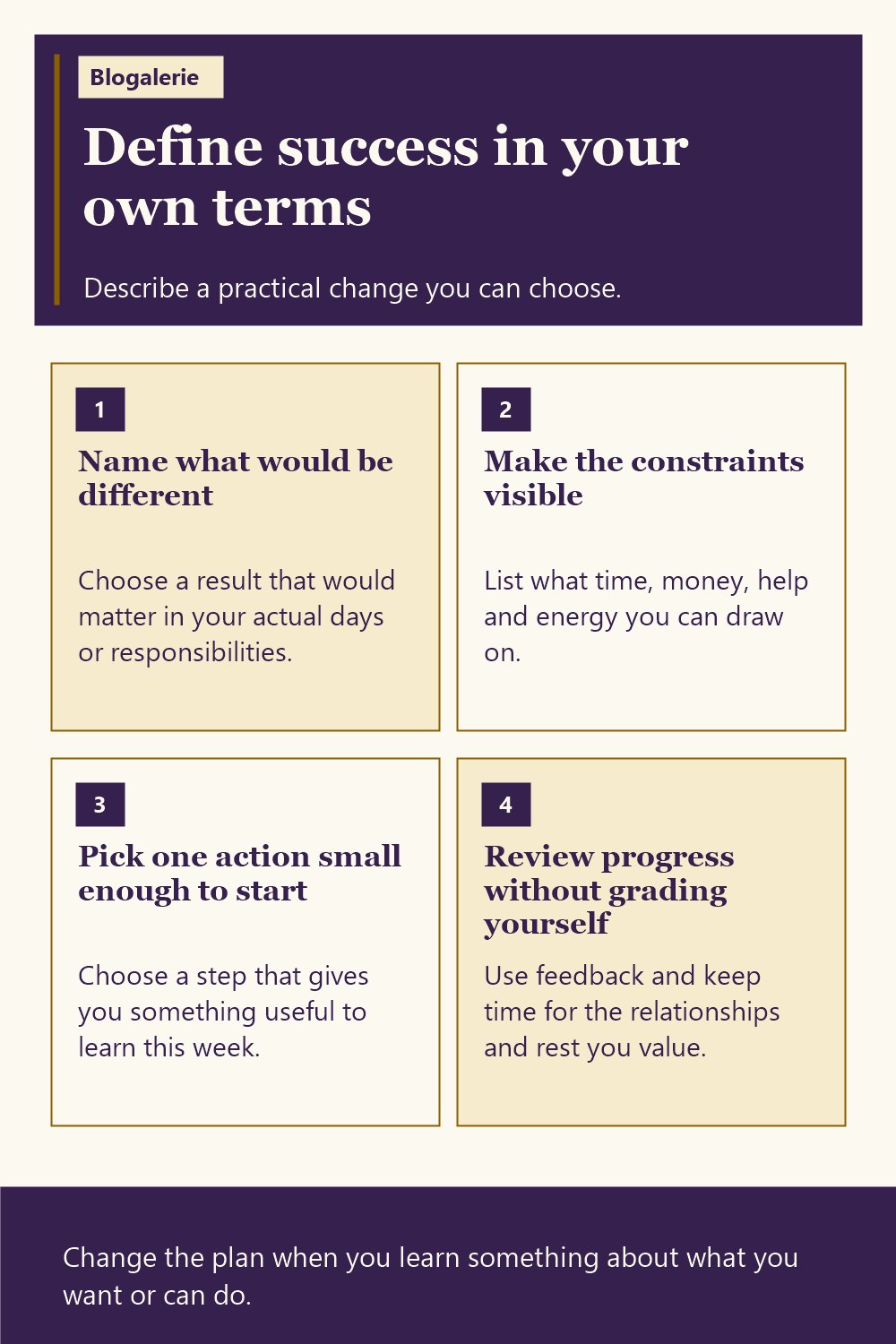
Read the infographic in text
Define success in your own terms Describe a practical change you can choose.
- Name what would be different Choose a result that would matter in your actual days or responsibilities.
- Make the constraints visible List what time, money, help and energy you can draw on.
- Pick one action small enough to start Choose a step that gives you something useful to learn this week.
- Review progress without grading yourself Use feedback and keep time for the relationships and rest you value.
Change the plan when you learn something about what you want or can do.
‘Be healthy both physically and mentally’ encapsulates a core tenet for sustained achievement—health cannot be overlooked when discussing success strategies. Regular exercise paired with intellectual engagement creates a robust foundation upon which one can build their ambitions. In light of this article’s arguments about personal responsibility, it’s clear that individuals hold significant power over their trajectories if they commit to cultivating both mind and body holistically rather than viewing them as separate entities.
This piece articulates several valuable principles that can contribute to individual success and happiness. The concept of ‘inverse paranoia’ is particularly thought-provoking, as it encourages one to view challenges through a lens of potential growth rather than victimhood. This shift in mindset could empower individuals to navigate adversity with resilience and creativity. Moreover, the emphasis on living in the moment serves as a reminder that our present experiences are integral to our overall well-being. As such, balancing action orientation with mindfulness could lead to more sustainable forms of achievement and satisfaction.
This article’s insights offer practical wisdom for navigating life’s complexities toward achieving happiness—especially pertinent amidst today’s challenges where clarity of purpose may be obscured by external noise or competing priorities; adopting these principles may indeed facilitate not only professional growth but also enrich one’s personal journey toward fulfillment.
‘Put yourself first’ strikes me as both empowering and potentially misinterpreted if taken too far into self-indulgence; it serves as an important reminder of maintaining boundaries while pursuing one’s aspirations without succumbing entirely to societal pressures or expectations—an intricate balance that many struggle with in their daily lives.’
I appreciate how this article reframes traditional views on success by highlighting non-materialistic values such as health and goal-setting. The call for minimalism aligns well with contemporary movements that advocate for sustainable living and conscious consumerism. It raises an essential point about detaching from material possessions to focus on what truly matters in life—our relationships and personal growth. Furthermore, the assertion that successful individuals are often those who act decisively rather than procrastinating underscores an important lesson in productivity and time management which is relevant across various fields.
‘Set a meaningful goal’ resonates deeply within contemporary discussions around purpose-driven work versus purely financial motivations. While financial stability is undeniably important, aligning one’s endeavors with intrinsic values leads to greater satisfaction over time—a sentiment echoed by numerous studies in positive psychology. It’s refreshing to see these ideas presented here without the usual clichés surrounding success narratives which often prioritize wealth accumulation over personal fulfillment.
‘The emphasis on setting meaningful goals opens up valuable dialogues about what constitutes true success today; it’s not just about monetary gains but also contributing positively to society through our work.’
The article presents an intriguing perspective on the nature of success. It emphasizes the importance of self-centeredness in a constructive way, distinguishing it from selfishness. This notion resonates with many successful figures in history who have pursued their passions without being swayed by public opinion. Furthermore, the suggestion to adopt a minimalist lifestyle is compelling; it promotes a focus on personal values rather than material possessions. I believe that by prioritizing mental and physical health alongside meaningful goals, individuals can cultivate a more fulfilling life experience. Overall, the guidelines offered here provide a holistic approach to personal development.
‘Being focused on action’ stands out as an especially poignant takeaway from this article. In today’s fast-paced society, where distractions abound, cultivating a proactive mindset is increasingly crucial for achieving one’s aspirations. It’s fascinating how success does not merely stem from external validation but also from internal fulfillment and commitment to one’s own values and goals. Additionally, prioritizing mental health by engaging with literature or current events reflects an admirable balance between self-improvement and social awareness—an approach I find particularly relevant in our interconnected world.