

Working motherhood can involve competing demands on time, money and care. A useful plan makes some of those demands clearer and more shared; it does not depend on you becoming endlessly efficient or available.
Choose the ideas that fit your work, household and current resources. A manageable week may need changes at work, reliable care or practical help as well as a routine you can use.
On this page
- Choose this week’s priorities
- Clarify expectations at work
- Share the planning as well as the tasks
- Make handovers clearer
- Simplify a daily transition
- Choose a career goal that fits now
- Keep useful evidence of your work
- Consider the whole opportunity
- Keep care and rest in the plan
- Find support and review
1. Choose this week’s priorities
List the commitments that genuinely need attention: work deadlines, care arrangements, appointments and something you need yourself. Distinguish those from extras that could wait.
Leave room for changes where you can. A schedule filled to the edge may need fewer commitments rather than a stricter effort to follow it.

2. Clarify expectations at work
If it is practical to discuss workload, make the decision clear: “I can complete the report today or prepare the presentation. Which has priority?” Ask what a useful finished task needs to include.
The NHS guidance on work-related stress includes discussing priorities, workload and support. You can ask a focused work question without sharing family or health details you want to keep private.
If an issue involves employment rights or a formal dispute, seek advice appropriate to your location and circumstances rather than assuming a particular arrangement is available.
3. Share the planning as well as the tasks
Where there are other responsible adults, agree who owns a task from noticing it through to finishing it. Booking an appointment, arranging transport and checking the details are all parts of the work.
A shared list can help only if people use it and take responsibility. You do not have to become the permanent reminder system for every task that has been assigned to someone else.
4. Make handovers clearer
Agree the essential information for a care handover: who is collecting, when, what needs to come along and how a change will be communicated. Keep relevant care instructions accessible to the responsible person.
Consider a backup for a likely disruption if one is available. If reliable care is missing, name that gap; it is a practical need that organisation alone cannot solve.
5. Simplify a daily transition
Choose one recurring pinch point, such as leaving home, starting a shift or returning in the evening. What would make that moment easier: a ready bag, a simpler meal, a clearer handover or fewer optional errands?
Try the smallest useful change. A familiar, workable meal or a short preparation list can be enough; the whole household does not need a new system at once.
6. Choose a career goal that fits now
You may want advancement, a different role, steadier hours or simply to maintain the work you currently have. Those are different goals, and none needs to stand in for every working mother’s definition of success.
If learning interests you, choose a skill or opportunity that fits your available time and support. Continual training or applying for every vacancy does not have to become another obligation.
7. Keep useful evidence of your work
Make a brief record of completed projects, skills used, helpful feedback or problems you solved. Keep confidential employer or client information within the appropriate work systems.
A factual record can help you prepare for a review, application or conversation about responsibilities. It does not need to become a daily score of whether you have done enough.
8. Consider the whole opportunity
Before accepting an extra role, course or shift, consider the actual terms: time, pay, travel, care arrangements, expectations and what you would have to stop doing.
You can ask for information or time to decide. An opportunity may be worthwhile, unsuitable now or dependent on support that is not yet in place. You do not have to accept immediately to prove ambition.
9. Keep care and rest in the plan
Notice the needs that keep being pushed aside: food, sleep, health appointments, time with someone you enjoy or a pause after a demanding task. Consider what could be shared or reduced to make room.
If the demands repeatedly leave no room for basic needs, seek practical support with the demands. A short break can be useful, but it cannot replace reliable care or a workable workload.
10. Find support and review
Other working parents, a trusted colleague or a relevant support service may offer information or company. Ask for the kind of help you need, and choose what you want to share.
At the end of a week, ask what worked, what changed and what needs a clearer agreement. Keep one useful adjustment rather than turning the review into another list of things you should have managed.
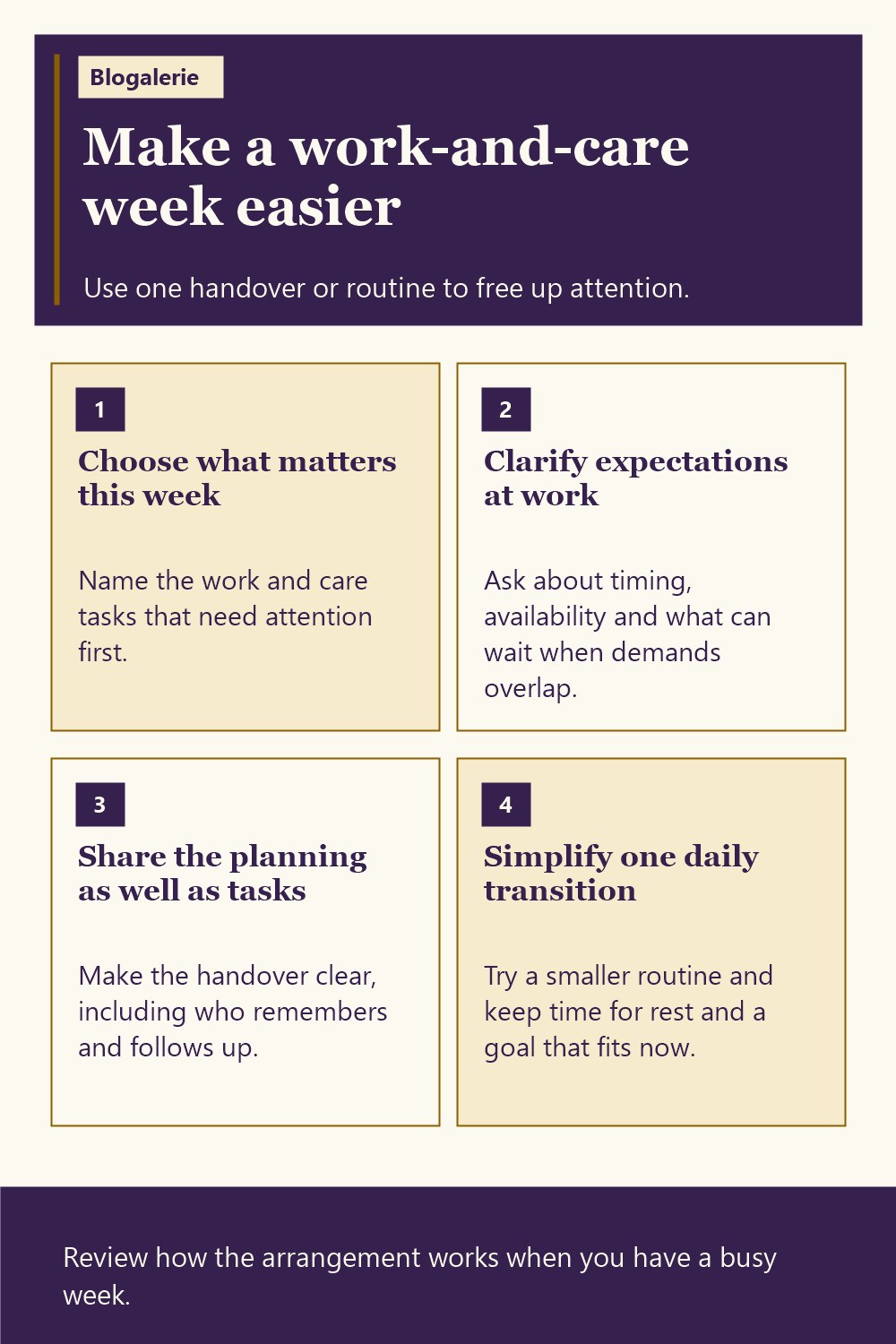
Read the infographic in text
Make a work-and-care week easier Use one handover or routine to free up attention.
- Choose what matters this week Name the work and care tasks that need attention first.
- Clarify expectations at work Ask about timing, availability and what can wait when demands overlap.
- Share the planning as well as tasks Make the handover clear, including who remembers and follows up.
- Simplify one daily transition Try a smaller routine and keep time for rest and a goal that fits now.
Review how the arrangement works when you have a busy week.
This article presents an essential framework for working mothers striving for success while managing multiple roles. The suggestion to share one’s skills and passions resonates deeply with me as it highlights the importance of networking and personal branding. Furthermore, the advice on organization at home cannot be overstated; a structured environment is conducive to both mental clarity and productivity. However, I believe that the point about letting go is crucial—accepting imperfection can significantly reduce stress levels for working parents navigating demanding schedules.
‘Being opportunistic’ is an interesting point that could lead to discussions about risk-taking versus strategic planning in career development. In my experience, recognizing opportunities often requires both intuition and calculated judgment which can vary greatly among individuals based on their circumstances.
The strategies outlined for working moms reflect a comprehensive understanding of both workplace dynamics and familial obligations. For instance, prioritizing weekly goals while simultaneously tracking distractions illustrates a balanced approach to productivity. Moreover, seeking mentorship from fellow working parents enriches one’s experience by providing diverse perspectives on common challenges. It would be interesting to further explore how these principles could be applied across different industries or varying workplace cultures, as flexibility might yield different results based on context.
Indeed! Understanding industry-specific nuances could enhance the effectiveness of these strategies significantly. It would also be beneficial if there were case studies included for real-world applicability.
I agree with your analysis regarding the application of these principles across various industries. Each sector has its own unique challenges that may require tailored strategies for success.
‘Connecting with other working parents is indeed invaluable for sharing insights; however, it raises questions about accessibility—how do we ensure equitable support systems for all? Some communities may lack such networks due to socioeconomic factors or geographical isolation.’
The insights shared in this article provide a pragmatic approach to balancing professional responsibilities and family life. Working moms often face unique challenges, and the strategies outlined here, such as prioritizing tasks and maintaining open communication with management, are essential in navigating these complexities. Additionally, the emphasis on continuous learning and self-reflection can empower individuals to embrace their roles more effectively. I find it particularly noteworthy that the article encourages mothers to be opportunistic; this mindset can foster resilience and adaptability in a rapidly changing work environment.
‘Letting go’ seems like a simple concept but carries profound implications in high-stakes environments where working mothers often operate under immense pressure. This notion encourages resilience but also invites a critical examination of how societal expectations influence our perceptions of success and failure in both personal and professional realms.