

Pressure can build when every task feels like a test of whether you are a good parent, partner, friend or colleague. Even an ordinary decision can become tiring if you believe there is only one acceptable way to get it right.
You may be able to loosen some of those expectations. Other demands come from workload, money, health or responsibilities that need practical support. Begin by working out what is creating the pressure, rather than assuming you should simply think more positively.
On this page
Name the demand
Choose one moment when you notice yourself rushing, checking repeatedly or feeling that you have fallen behind. What are you asking yourself to do? Try writing the expectation as a sentence: “I must answer every message immediately” or “Everyone must enjoy the occasion.”
Then ask where that rule came from. It may be a real requirement, an assumption about what someone wants, a habit from another period of your life or a standard you have seen online. Those situations call for different responses.
A deadline that affects other people may need discussion. An imagined requirement to produce a perfect meal may be something you can change yourself. You do not have to treat both as equally urgent.

Decide what is enough for this task
Set a stopping point before you begin. For a routine email, that might mean giving the necessary information, checking the recipient and reading it once. For a gathering, it might mean accessible food, somewhere to sit and a clear time to arrive.
Keep the level of care appropriate to the consequences. A safety check, care instruction or important financial detail deserves attention. Decorative extras and a casual message usually allow more flexibility. Reducing unnecessary polishing does not mean abandoning care.
Consider your available time, energy and budget. A plan that depends on resources you do not have needs an adjustment, not a harsher opinion of you.
Ask for a workable agreement
When the demand involves someone else, make the trade-off visible. Explain what you can do, what you cannot fit and which decision needs their input.
“I can finish the summary today or complete the detailed version on Thursday. Which would be more useful?”
At home, the conversation might be, “I can organise the appointment, but I need you to arrange transport,” or “I would like a quieter celebration this year.” A specific request gives the other person something concrete to respond to.
You may not be able to negotiate every responsibility. If someone has power over your work, housing or care, consider what support is available before raising a difficult issue. A trusted colleague, representative or relevant advice service may help you consider your options.
Give comparison less attention
Notice which comparisons leave you feeling that you should have a different body, relationship, home or life timetable. A photograph or announcement gives you limited information about another person’s circumstances.
You can mute an account, reduce repeated checking or choose a different way to keep in touch. It can also help to ask what you actually want, apart from keeping up: more companionship, a manageable home, time for an interest or enough rest.
Life choices do not need to follow the same sequence. Being single, changing plans or wanting something different from your friends does not require a defence. You can keep a decision private while you work it out.
Respond to yourself with care
When something goes wrong, describe the event before judging your character. “I forgot to reply” leaves room for an apology and a new reminder. “I am a terrible friend” turns one action into a much larger conclusion.
You do not need to insist that the problem is trivial. Something can matter and still deserve a measured response. Ask what needs repair, what can wait and what help would make the next step more manageable.
Make room for an ordinary care need, such as a meal, a pause or some company. Choose what is accessible to you. A calming activity may help you take a break, but it cannot guarantee that a worry will disappear or remove the demand causing it.
Find support for the situation
The NHS guide to stress describes practical options including breaking tasks into smaller parts and talking with someone you trust. Pick an option that addresses what is happening in your own day.
If pressure is persistently affecting sleep, relationships or everyday functioning, consider speaking with a qualified health professional. If the demand is an excessive workload, lack of care support or another practical problem, help with that situation matters too.
For today, choose one expectation to clarify or reduce. You might stop after a reasonable check, ask which task has priority or leave an optional extra undone. Review whether the change was useful and adapt it when your circumstances change.
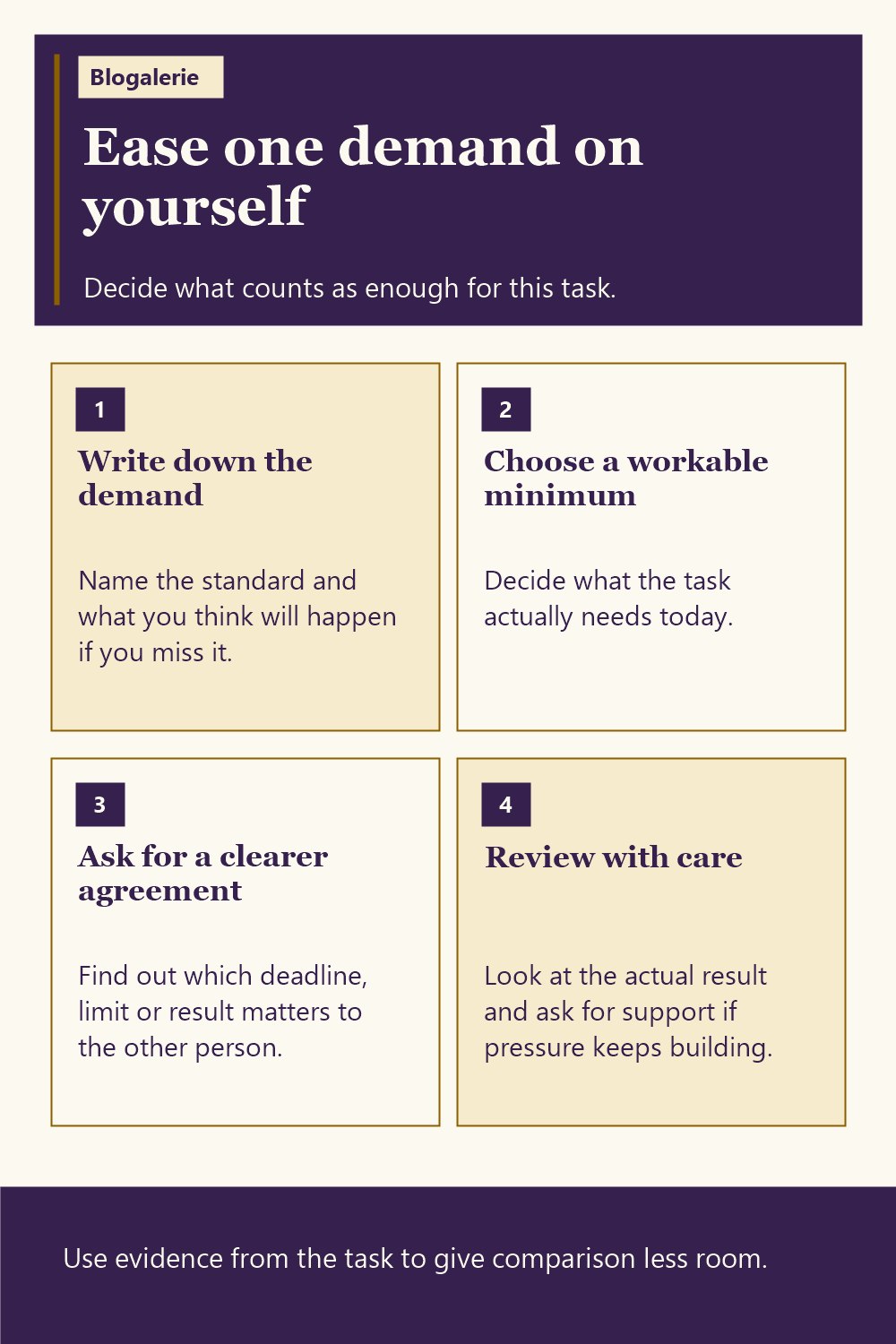
Read the infographic in text
Ease one demand on yourself Decide what counts as enough for this task.
- Write down the demand Name the standard and what you think will happen if you miss it.
- Choose a workable minimum Decide what the task actually needs today.
- Ask for a clearer agreement Find out which deadline, limit or result matters to the other person.
- Review with care Look at the actual result and ask for support if pressure keeps building.
Use evidence from the task to give comparison less room.
The call for compassion towards oneself is paramount in this discourse about perfectionism and anxiety management. There’s significant wisdom in reminding individuals that life should be navigated from a place of acceptance rather than constant striving for unattainable ideals.
‘It’s fascinating how quickly we can fall into cycles of comparison without realizing their impact on our mental well-being.’ This piece serves as a wake-up call about redefining success beyond superficial indicators.
This article raises essential points about the illusion of perfection perpetuated by social media platforms. The suggestion to assess our own expectations critically is vital; unrealistic goals can indeed lead to burnout or emotional breakdowns. The narrative encourages readers to embrace their imperfections, which I find refreshing in today’s environment where comparison is rampant. The notion of developing personal mantras could serve as an effective tool for many seeking balance and self-acceptance in their daily lives.
This article elegantly addresses a pervasive issue facing many today: societal pressures leading us away from authenticity. By recognizing external influences shaping our expectations, we gain agency over our emotional experiences—an empowering realization amid chaos.
‘In times characterized by digital interactions, the pressure to maintain an ideal image has reached unprecedented levels.’ This article effectively captures that sentiment while providing actionable steps towards healthier self-perception.
The article provides a compelling argument for the pressures of modern life, particularly regarding social media and its influence on self-perception. It emphasizes the need for realistic expectations, which I find to be a crucial point. Living in an age where curated images dominate our feeds can certainly lead to feelings of inadequacy. The discussion around personal mantras as tools for self-acceptance is particularly interesting, as it suggests a proactive approach to combating societal pressures. Overall, the author’s insights on emotional health resonate strongly with contemporary issues.
I appreciate the nuanced exploration of perfectionism presented in this piece. It highlights the often-unrealistic standards we impose on ourselves and others, which can lead to significant psychological distress. The emphasis on recognizing and externalizing pressure is a practical technique that merits further examination. This approach not only fosters self-awareness but also encourages healthier coping mechanisms. Furthermore, the reminder that no one is perfect serves as an important reminder in our pursuit of authenticity amidst societal expectations.
The discussion on mental health and societal pressures resonates deeply with many individuals today. As we navigate various roles in our lives, it becomes increasingly important to recognize when we are setting ourselves up for failure with impossible standards. I found the concept of associating pressure with external negative sensations intriguing; it offers a tangible way to visualize and mitigate stressors. Additionally, acknowledging that everyone experiences off days reminds us that vulnerability is part of being human.
‘Acknowledging vulnerability indeed opens up avenues for genuine connection among individuals.’ This aspect should not be underestimated, especially when discussing mental health topics where stigma often prevails.
‘I agree completely; embracing our flaws allows us to foster deeper relationships both with ourselves and others.’ It’s an essential step towards building resilience against external pressures.