

Disappointment can hurt even when a relationship never began. You may miss a friendship, a brief connection or a future you hoped for. Those feelings do not need a dating history to count, and you do not have to call them “fake” to start caring for yourself.
Moving on can mean giving less of your time and attention to an unavailable possibility. It does not require proving that the person was wrong for you, finding someone else immediately or reaching a point where you never think about them. Begin with the information and choices you have now.
On this page
1. Name the loss without inventing the relationship
Ask what you hoped would happen. Perhaps you imagined dating, wanted a friendship to become romantic or expected another conversation after meeting once. Being specific can help you separate a real interaction from the future you pictured.
You may know qualities you liked while knowing little about life together. You do not need to turn the person into a perfect partner or imagine that a relationship would inevitably have gone badly. Both stories ask you to decide something you cannot know.
Try a more grounded sentence: “I wanted a relationship with them, and that is not the relationship available now.” You can feel sad about that limit. It does not establish that you were foolish to care or that every future connection will end the same way.

2. Work with what the person has actually said
If they have declined a date or asked for no contact, respect that answer. You do not need another explanation before you stop pursuing them. A friendly conversation, compliment or social media reaction does not overturn a refusal.
If you have not asked and an invitation would be appropriate, you can choose one clear, low-pressure question. You can also decide not to ask. Avoid repeated invitations after a refusal or an unanswered invitation, and do not ask friends to persuade the person for you.
Where the situation remains unclear, consider the pattern and the connection actually being offered. Our guide to uncertain interest, clear questions and boundaries explores this without treating gestures as proof of private feelings.
The Mental Health Foundation’s relationship guidance emphasises respecting boundaries and recognising the difference between your actions and another person’s choices. You can decide how you participate without finding a way to change their feelings.
3. Choose distance that fits your circumstances
Notice what keeps drawing you back into waiting. It might be checking their profile, rereading a conversation or arranging your plans around the chance of meeting. Choose one habit to interrupt rather than demanding that the feeling disappear.
- Mute updates or put a conversation out of immediate view if checking it is unhelpful.
- Ask friends not to bring you reports about the person’s dating life.
- Pause optional one-to-one plans if friendship is keeping you in a role you do not want.
- Choose what to do when you want to check again, such as contacting a friend or returning to an ordinary task.
If you work, study or share responsibilities together, complete avoidance may be impractical. Keep necessary contact courteous and focused on the task. You can reduce personal conversation without announcing your feelings to everyone or asking others to exclude the person.
Distance is a choice about your participation. It should not become monitoring, a test to make someone miss you or a punishment for declining romance. Respect their privacy as well as your own need for space.
4. Give your days more than one focus
Choose one part of life that needs attention today: a meal, an appointment, time with someone you trust or an activity that has slipped away. Keep the step modest enough to fit your energy, money and responsibilities.
You might tell a friend, “I am disappointed about someone I hoped to date. Could we spend some time together without trying to solve it?” Company does not have to involve a long discussion. A shared task or familiar activity may be more welcome.
Rebuilding a routine is not a project to become attractive enough for the person to reconsider. Nor do you need to start dating as proof that you have recovered. Make room for relationships and interests you actually want, at a pace you choose.
For help considering your next choices without turning a setback into a verdict on your worth, explore these practical lessons about boundaries, changing plans and self-respect.
5. Ask for support without setting a deadline
A thought or feeling returning does not mean you have undone every change. Ask whether your current arrangements help: Are you spending less time waiting? Keeping important plans? Receiving support? You can adapt the arrangement if something is still making daily life harder.
You do not need to manage persistent distress alone. If the situation is affecting sleep, work, study or caring for yourself, consider speaking with a qualified mental health professional. Explain what is happening and how it affects you; a formal relationship history is not a prerequisite for asking for help.
For now, choose one practical response: stop seeking another answer after a refusal, change a checking habit or ask someone for company. You can acknowledge what you wanted while giving your time and attention to the life available to you today.
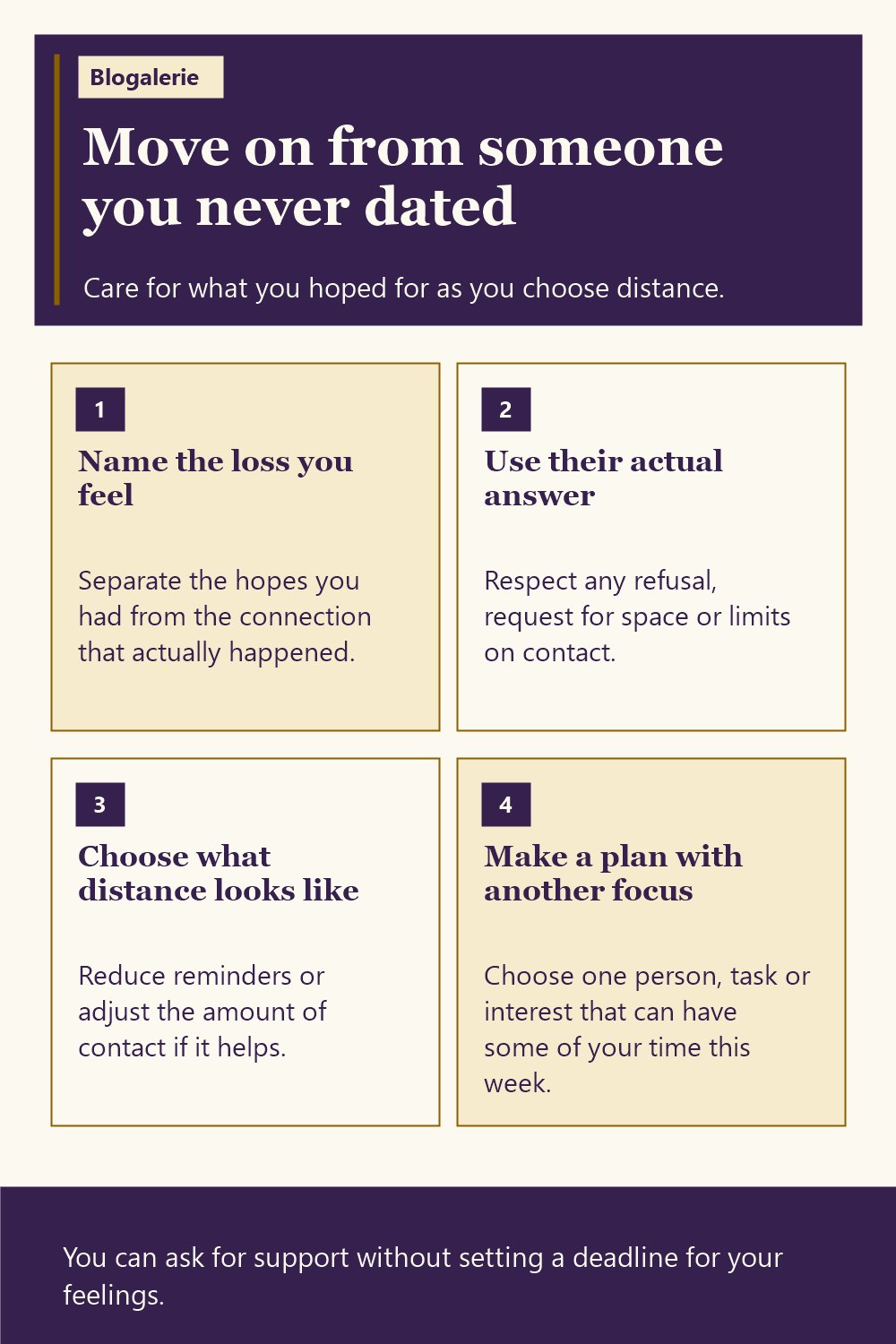
Read the infographic in text
Move on from someone you never dated Care for what you hoped for as you choose distance.
- Name the loss you feel Separate the hopes you had from the connection that actually happened.
- Use their actual answer Respect any refusal, request for space or limits on contact.
- Choose what distance looks like Reduce reminders or adjust the amount of contact if it helps.
- Make a plan with another focus Choose one person, task or interest that can have some of your time this week.
You can ask for support without setting a deadline for your feelings.
The exploration of unrequited or unrealized relationships is both fascinating and complex. The author effectively articulates how unfulfilled potential can lead to a cycle of speculation and longing, which ultimately hampers one’s ability to form new connections. This phenomenon illustrates the human propensity to dwell on ‘what ifs’ instead of accepting the reality of a situation. Recognizing this tendency allows individuals to confront their thoughts more objectively and move toward healthier coping mechanisms, thereby promoting personal development.
The concept of closure, or the lack thereof, significantly impacts our emotional well-being. When one has never truly engaged in a relationship, the brain tends to create narratives that fill in the gaps left by uncertainty. It is interesting how our minds can build idealized versions of potential relationships that never existed. The article rightly suggests that this yearning for what could have been can inhibit personal growth and future connections. Understanding that these feelings are often projections rather than realities is crucial for emotional health.
This article addresses an often overlooked aspect of human relationships—the challenge of moving on from someone we never dated. The psychological implications of lingering feelings toward such individuals reveal much about human nature and attachment theory. We tend to romanticize potential connections, which may lead to unhealthy fixation and distraction from current opportunities for meaningful relationships. Acknowledging that these feelings stem from unfulfilled desires rather than actual experiences can be liberating and pave the way for healthier emotional habits.
‘Moving on’ seems simple yet is often fraught with complications stemming from psychological attachments that remain unresolved due to lack of experience within a relationship context. The author’s suggestions for finding closure resonate deeply with anyone who has experienced similar situations—be it through self-reflection or seeking professional help when necessary—thereby fostering resilience and encouraging emotional maturity as we navigate interpersonal relationships.
‘The complexities surrounding unattainable desires are expertly encapsulated within this piece; it highlights not just romantic inclinations but broader themes related to desire, expectation versus reality, closure, growth—and ultimately moving forward amidst life’s uncertainties! A commendable read for anyone grappling with similar sentiments while searching for clarity amidst confusion.’
It is intriguing how our minds can cling to hypothetical scenarios, especially in the realm of romance. The article insightfully outlines how these imagined relationships might prevent us from fully engaging with those who are genuinely interested in us. It’s essential to acknowledge that our idealizations are often based on limited information, leading us away from potentially fulfilling connections that exist in reality. Engaging with a therapist or counselor may provide valuable insights into why we hold onto these illusions and help facilitate emotional healing.
‘Imagined relationships’ indeed reflect our deepest desires but also underscore our vulnerabilities as humans seeking connection. The author provides a clear pathway toward understanding these dynamics through self-reflection and professional guidance if needed. By recognizing these patterns early on, we can learn not only about ourselves but also about navigating future relationships with greater awareness and intention.
‘Getting over someone you never dated’ embodies an existential dilemma many face yet rarely articulate; it’s a poignant reminder of how human emotions can distort perception regarding romantic possibilities based solely on mere interactions or fantasies rather than lived experiences together—a theme worth exploring further in psychological discourse concerning attachment styles among individuals today.
‘Never dated’ scenarios often leave individuals grappling with unresolved emotions that may hinder their ability to move forward emotionally. The article emphasizes the importance of acknowledging one’s feelings while simultaneously recognizing their fictitious nature, which is crucial for healing. It invites readers to confront their thoughts critically rather than succumb to them passively—an approach I find particularly valuable in contemporary discussions around mental health and relationship dynamics.