

Karma can be a meaningful way to reflect on how you act and what you contribute to other people’s lives. If you understand it as a spiritual belief, you can explore that meaning while remaining careful about claims that every experience is a reward or punishment.
The practical questions are close to home: what happened, who was affected, and what can you choose now? You do not have to explain someone’s suffering through a supposed cosmic debt to take responsibility for your own behaviour.
On this page
- Consider what karma means to you
- Look at the action and its effects
- Allow other people their own response
- Use your values when the choice is difficult
- Notice a pattern without assuming destiny
- Treat a list of karmic laws as reflection prompts
- The great law: consider consequences
- Creation: choose a contribution you can make
- Humility: leave room to learn
- Growth: make the change specific
- Responsibility: own what belongs to you
- Connection: care with boundaries
- Focus: choose where to put your attention
- Giving and hospitality: offer without a hidden bargain
- Here and now: work with the present situation
- Change: try a different response
- Patience and reward: allow effort without a promise
- Significance: value ordinary contributions
- Leave room for hope and difficult feelings
Consider what karma means to you
Begin with your own understanding rather than treating a short list of rules as a complete account of everyone’s beliefs. Does karma remind you to act with care, consider consequences or reflect on a spiritual path?
You can hold that meaning without claiming certainty about another person’s past, future or reasons for suffering. Ask how the belief affects the way you treat people today.

Look at the action and its effects
A generous intention is worth considering alongside what actually happened. An offer of help may be useful, unwanted or more complicated than you expected. Ask the person what would assist them instead of assuming.
If something went wrong, describe the action specifically. This makes it easier to learn or repair than deciding you are entirely good or bad.
Allow other people their own response
You can choose to act kindly; you cannot require gratitude, affection or an equivalent favour. Another person’s reaction may reflect circumstances you do not know.
Offering support does not purchase a relationship or override a refusal. Decide what you can give freely and keep your limits clear before making the offer.
Use your values when the choice is difficult
A strong feeling about the right thing to do may be a starting point. Also check the facts, agreements and needs involved. Consider whether the choice respects another person’s privacy and consent.
When two values compete, name the conflict. Being loyal to a friend, for example, need not mean covering up harm they caused.
Notice a pattern without assuming destiny
If a difficulty keeps recurring, look for something observable: an unclear agreement, an avoidable commitment or an environment that leaves you unsupported. Ask what could change.
A repeating problem does not establish that you are cursed or paying for another lifetime. Some barriers require practical help, resources or a different arrangement.
Treat a list of karmic laws as reflection prompts
You may encounter lists described as “the laws of karma.” This article uses the familiar labels below as prompts for everyday reflection, rather than presenting them as universal facts or a complete religious teaching.
Take time to consider which ideas fit your beliefs. You do not need to adopt a whole system to find one useful question.
The great law: consider consequences
Before acting, ask who could be affected and what a reasonable consequence might be. Sharing a private story, for example, can affect someone even if you meant to entertain a friend.
Consequences are not always immediate or fair. A kind person can experience loss; a harmful action may go unchallenged. Neither observation determines someone’s worth.
Creation: choose a contribution you can make
Choose one part of a situation where you have some influence. You might send an accurate update, clear up a misunderstanding or make a more realistic commitment.
Creating a better condition for change differs from controlling the entire outcome. Other people’s decisions and access to time, money or support still matter.
Humility: leave room to learn
Ask what you might be missing before making a confident judgment. Listen when someone describes the impact of your behaviour, even if it differs from your intention.
Humility does not require accepting insults or denying what you know. You can revise a mistake while maintaining a clear boundary.
Growth: make the change specific
Rather than promising to become a completely different person, choose a behaviour you can practise. “I will check before sharing your news” is clearer than “I will be more thoughtful.”
Notice whether the change helps the people involved. Growth can include asking for support or changing an unrealistic expectation.
Responsibility: own what belongs to you
If you caused harm, an apology can name what you did and acknowledge its effect. Where appropriate, offer a practical repair without demanding immediate forgiveness.
Responsibility has limits: another person’s choice to threaten, deceive or mistreat you is theirs. Being harmed is not evidence that you deserved it.
Connection: care with boundaries
You may feel connected to people, community or the wider world. Consider what that connection asks of you in a particular situation: listening, sharing a resource or respecting someone’s request for space.
Connection does not mean permanent access. You can care about someone and decide that contact is no longer safe or wanted.
Focus: choose where to put your attention
Pick one task that fits your current capacity. Completing a clear, limited action may give you more information than repeatedly checking whether your energy feels positive.
You are allowed to rest or change direction. Thoughts and feelings do not have to be perfectly controlled before you can make a useful choice.
Giving and hospitality: offer without a hidden bargain
Before giving time, money or a place to stay, consider what you can afford and what you are agreeing to. Clear terms can protect everyone from an uncomfortable assumption.
A gift does not guarantee a later reward. If you need repayment or help in return, discuss that openly as an agreement.
Here and now: work with the present situation
The past may help explain a concern, but today’s decision needs current information. Ask what is happening now and what would make the next hour or conversation more manageable.
Being present does not require forgetting a loss or abandoning a valid complaint. Leave room for those experiences while deciding your next step.
Change: try a different response
If an approach is not helping, consider a smaller request, a clearer limit or another source of support. You can review what happened without treating it as a verdict on your spiritual progress.
Change may also mean stopping a commitment that is no longer workable. Continuing indefinitely is not the only way to show care.
Patience and reward: allow effort without a promise
Some worthwhile efforts take time; others need revision because the conditions are wrong. Set a point to review what you have learned rather than waiting forever for a promised payoff.
A delayed or disappointing result does not prove insufficient belief. Consider what support or information could help you decide whether to continue.
Significance: value ordinary contributions
A small, reliable action can matter to the person receiving it. Keeping a confidence or following through on a modest promise may be more useful than making a dramatic declaration.
You also have value when you cannot contribute much. This guide to a fairer view of yourself explores expectations, self-criticism and support.
Leave room for hope and difficult feelings
Anger, disappointment and worry do not make you a bad person or cancel a kind action. Ask what the feeling is drawing your attention to, then choose a response that fits your values and circumstances.
Start with one concrete choice: check a fact, ask consent, make repair or rest before answering. If you use visualisation or affirmations, our guide to hope and practical action can help you keep the next step manageable.
When you are upset about how someone treated you
You might decide to keep a boundary, speak to someone you trust or raise the matter appropriately. Your view of karma can help you decide how you want to act without leaving every choice to fate.
If you caused harm, look at who was affected and what a repair might involve. Let the other person decide how to receive your response.
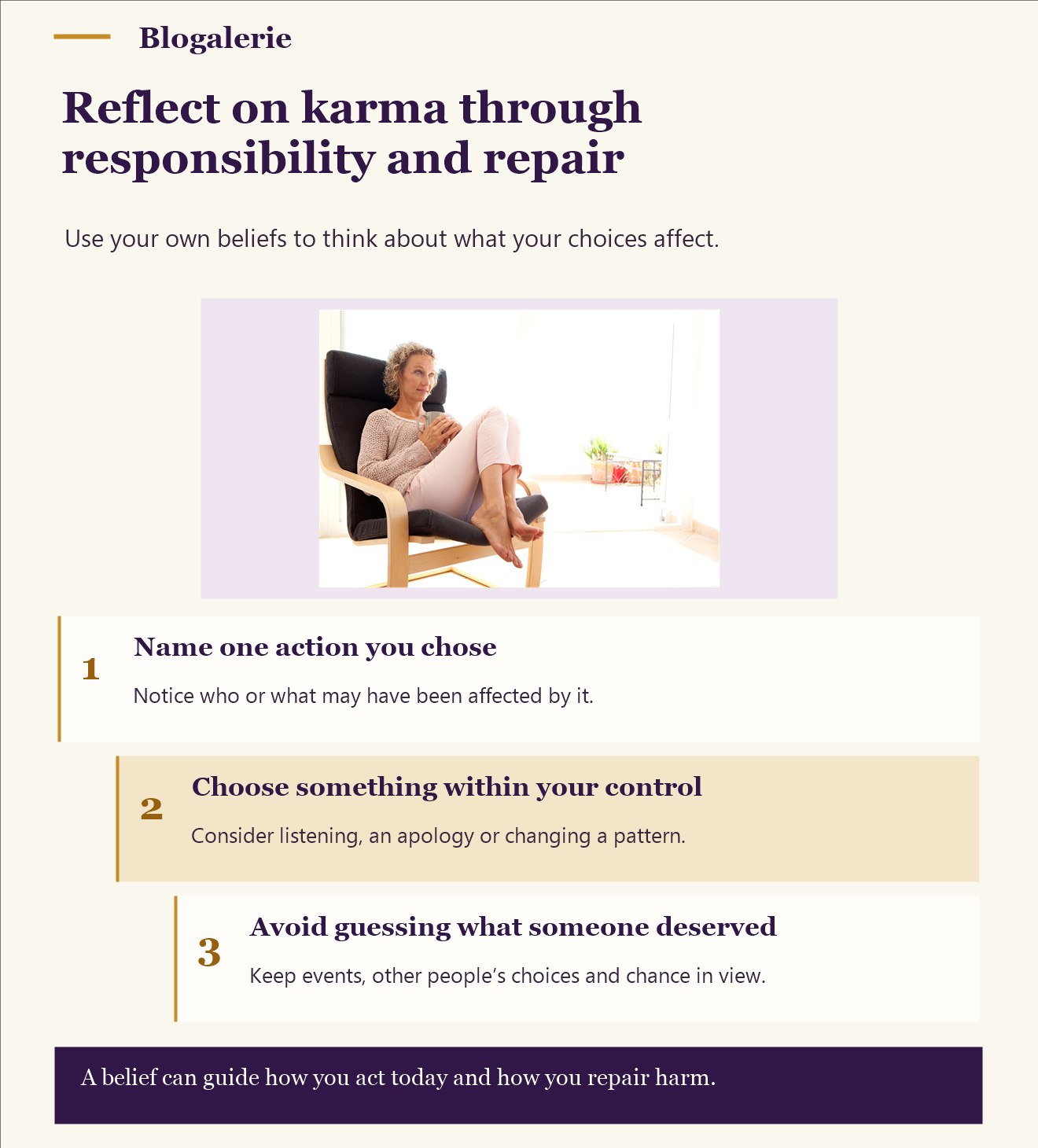
Read the infographic in text
Reflect on karma through responsibility and repair
Use your own beliefs to think about what your choices affect.
- Name one action you chose Notice who or what may have been affected by it.
- Choose something within your control Consider listening, an apology or changing a pattern.
- Avoid guessing what someone deserved Keep events, other people’s choices and chance in view.
A belief can guide how you act today and how you repair harm.
The exploration of karma as a concept offers a fascinating lens through which to view human behavior. It underscores the interconnectedness of actions and their consequences, emphasizing that even seemingly trivial acts can have significant repercussions in one’s life. This notion compels individuals to reflect on their daily interactions and the underlying motivations driving their behavior. The article aptly highlights how positive actions often yield positive results, reinforcing the idea that our experiences are largely shaped by our own choices. It would be interesting to further delve into the psychological implications of believing in karma and how this belief influences decision-making processes.
“The discourse around karma certainly invites reflection on behavioral ethics beyond mere reciprocity; it urges an exploration into deeper moral philosophy concerning altruism versus self-interest—how do we truly define ‘good’ versus ‘bad’ when intentions often intertwine? By recognizing these nuances inherent within human motivations behind each action taken (or omitted), one may cultivate richer dialogues surrounding ethics rooted not just within one’s self but extending outwardly toward mutual understanding across diverse communities navigating through complexities resulting from historical contexts influencing present realities.
“The Great Law” presents an intriguing perspective on causality; however, I wonder if this deterministic view limits our understanding of chance occurrences that occur independently from individual actions? While acknowledging personal responsibility is vital for ethical growth, we must also remain open to accepting life’s unpredictability without attributing every circumstance solely to past deeds—after all, random events do shape our paths significantly alongside deliberate choices made along the journey!
The discussion surrounding karmic laws is quite enlightening, particularly the notion that our actions inevitably return to us in some form. This principle can serve as a moral compass, guiding individuals toward more mindful living. However, it raises questions about accountability and the randomness of life events. Are we genuinely responsible for every outcome we experience? While karma provides a structure for understanding consequences, it may also oversimplify complex human experiences where intent does not always correlate with result. The interplay between personal responsibility and external circumstances is worthy of deeper investigation within this framework.
“Embracing positivity while acknowledging life’s inherent challenges forms an essential part of fostering resilience amid uncertainty—a valuable takeaway presented here! In essence: cultivating gratitude transforms perspectives over time regarding seemingly mundane interactions experienced daily; each moment possesses potentiality waiting to be harnessed toward creating fulfilling lives interconnected harmoniously through kindness shared among fellow beings navigating existence collectively together—an ideal vision worth pursuing consciously moving forward into tomorrow’s uncertainties!
“The Law of Here and Now” resonates profoundly amidst today’s fast-paced life filled with distractions from past regrets or future anxieties. Focusing on present actions aligns beautifully with mindfulness practices prevalent in modern psychology, which advocate for intentional living over reactive tendencies shaped by past experiences. This emphasis could significantly transform interpersonal dynamics when people become more aware of their immediate effects on others rather than being preoccupied with previous grievances or future expectations—a practice worth advocating widely within educational systems or community programs aimed at fostering healthier relationships.
Karma serves as a powerful reminder of the cyclical nature of existence and the importance of ethical behavior in societal contexts. The twelve karmic laws articulated here resonate with both philosophical traditions and contemporary ethical theories. Particularly compelling is the Law of Responsibility, which emphasizes personal agency in shaping one’s destiny. This perspective challenges individuals to reconsider their role within broader social constructs and encourages active participation in creating positive change rather than passive acceptance of circumstances. Additionally, exploring how different cultures interpret karma could provide valuable insights into its universal relevance or contextual limitations.
The concept that one’s actions generate corresponding reactions is foundational not only in philosophy but also in many spiritual teachings across cultures. The article effectively captures this essence by presenting karma as both an individual guide and a collective force impacting society at large. I find it particularly noteworthy how it addresses both benevolent acts leading to positive outcomes as well as negative behaviors returning unfavorable results—this duality emphasizes balance within human interactions. Understanding this cycle could potentially foster greater empathy among individuals if they recognize that harmful actions ultimately affect oneself as much as others.
Indeed, InsightfulOtter! It’s essential to consider how these principles apply not just at an individual level but also on societal scales—especially regarding justice systems or community engagement initiatives that reflect karmic concepts in action.