

Feeling uninspired does not mean you have no interests or have wasted your potential. You may need rest, a change of pace, more information or a smaller question. You can explore what interests you without turning it into a career or a complete plan for your life.
Choose one or two questions below. Write a few words, talk them through with someone you trust or simply notice what comes to mind. You can leave a question unanswered and return to it later.
On this page
- 1. What am I curious about lately?
- 2. Which part of an enjoyable activity matters to me?
- 3. What would I try with a little more room?
- 4. When is it easier to become interested?
- 5. Whose example helps me, and which part?
- 6. What would I enjoy without needing to improve?
- 7. Which strengths do I want to use?
- 8. What am I tired of carrying?
- 9. Who could make exploration easier?
- 10. What small experiment will I try next?
1. What am I curious about lately?
Think about something you paused to read, watched closely or wanted to ask about. It can be ordinary: how a recipe works, the history of a place or how a neighbour grows herbs. Curiosity does not have to look impressive.
Try following one thread with a library book, a short tutorial or a conversation. Notice whether you enjoy the activity itself, rather than deciding immediately whether you are good at it.
2. Which part of an enjoyable activity matters to me?
An interest often has several parts. Cooking might appeal because of the flavours, the planning, the chance to experiment or the company at the table. Enjoying one part does not mean you have to enjoy all of them.
Ask what a smaller version could look like. If you like choosing colours but not finishing a large project, arranging a small display may suit you better than redecorating a room.
3. What would I try with a little more room?
Imagine having a little more time, support or money. What would you use it for? Then bring the idea back to your circumstances: what is possible now, what would need preparation and what can wait?
A wish to travel could begin with learning about a place. You do not need to dismiss bills, caring responsibilities or accessibility needs to make room for an interest.
4. When is it easier to become interested?
Notice the conditions around a good moment. Was the task short? Were you alone, with company or away from interruptions? Did someone explain the first step clearly?
Those details may suggest a useful adjustment. Trying a quieter setting or a shorter session can tell you more than repeatedly asking yourself to feel motivated.
5. Whose example helps me, and which part?
You might admire how someone listens, makes things or protects time for their family. Name that particular behaviour. You do not have to copy their whole life, personality or career.
If you know them well enough, ask a practical question about how they began or what was difficult. Remember that an outside view, especially online, leaves out much of a person’s circumstances.
6. What would I enjoy without needing to improve?
Some activities can simply be pleasant. You can draw, listen to music or learn a few words of a language without selling the result, sharing it or keeping a streak.
Ask whether turning every interest into another goal is making it harder to begin. A hobby can stay small and private.
7. Which strengths do I want to use?
Think of a recent situation you handled in a way you appreciated. Perhaps you explained something clearly, noticed a detail or made someone welcome. Be specific about what you did.
A trusted person may offer another perspective, but their answer is information to consider. You decide which abilities you want to develop or use less often.
8. What am I tired of carrying?
Sometimes the next useful step is reducing pressure. Is there an unnecessary expectation, an unclear task or a commitment that needs renegotiating?
Separate a lack of interest from a lack of capacity. If something matters but you are exhausted, a smaller commitment, practical help or a break may be more useful than a new challenge.
9. Who could make exploration easier?
Consider company, information and access. Someone might suggest a local group, explain a skill or help you understand what an activity involves. Ask for one specific kind of help.
You can also ask about costs, transport, equipment or accessible options before committing. A suitable opportunity needs to fit your circumstances as well as your interests.
10. What small experiment will I try next?
Choose something limited enough to stop or change: borrow one book, try one recipe or spend a few minutes sketching. Decide when you will try it and what you want to notice.
Afterwards, ask whether you enjoyed any part, what made it difficult and whether you want another attempt. An experiment that does not interest you still provides useful information.
If your lack of interest is persistent, distressing or affecting daily life, consider speaking with a healthcare professional. Reflection questions can support exploration, but you do not have to manage a difficult period alone.
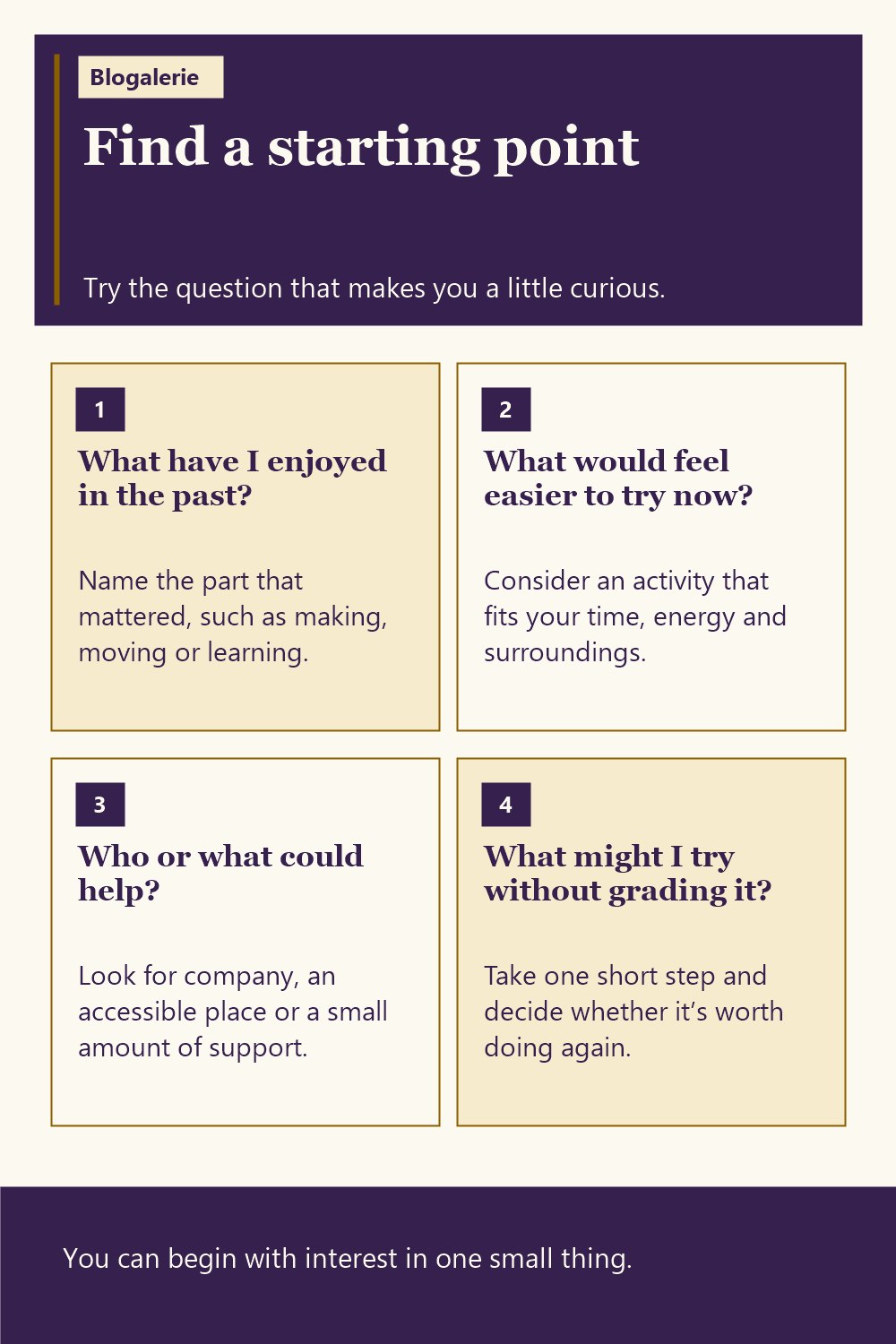
Read the infographic in text
Find a starting point Try the question that makes you a little curious.
- What have I enjoyed in the past? Name the part that mattered, such as making, moving or learning.
- What would feel easier to try now? Consider an activity that fits your time, energy and surroundings.
- Who or what could help? Look for company, an accessible place or a small amount of support.
- What might I try without grading it? Take one short step and decide whether it’s worth doing again.
You can begin with interest in one small thing.
The idea of exploring various sections in a bookstore is fascinating, as it reflects individual interests and intellectual curiosities. Each genre offers distinct perspectives on human experience; for example, memoirs provide intimate insights into others’ lives, while science books offer empirical understanding of the world around us. This exercise could serve as a catalyst for discovering new passions or deepening existing ones. Ultimately, one’s preferred genre may reveal underlying values or aspirations that deserve further exploration.
‘What kind of a kid was I?’ Reflecting on one’s childhood offers valuable insights into personality development over time. These memories shape who we are today; thus revisiting them can unearth forgotten passions or dreams which may still hold relevance as adults seeking fulfillment.
‘What do individuals want me to help them with?’ This question highlights an often-overlooked aspect of interpersonal relationships: the role we play in supporting others. Understanding how we contribute positively to those around us not only enhances our connections but also helps clarify our own strengths and abilities—essential components for building self-esteem.
‘What makes me feel secure?’ The exploration of security—be it emotional, financial, or relational—is vital for mental well-being. Each person has unique factors contributing to their sense of stability; recognizing these can empower individuals to create environments where they thrive best. Addressing insecurities head-on allows for more profound self-acceptance and ultimately aids in personal development.
Reflecting on one’s role models is indeed an enriching exercise. It allows individuals to identify traits they admire and may wish to emulate. This article encourages us to think beyond conventional success metrics and focus on qualities that resonate with our sense of self. For example, someone might find inspiration in the resilience of a historical figure rather than their achievements alone. Such reflections can lead to profound personal growth as we strive to embody those qualities within our own lives.
‘What do the individuals closest to me say I’m best at?’ Seeking feedback from loved ones serves as an excellent way to gain perspective on one’s strengths and talents—areas where you might excel without fully realizing it yourself can be revealed through their eyes.
‘What can I talk about easily for hours?’ This question underscores the importance of self-awareness in nurturing relationships and personal growth. Engaging deeply with topics that ignite passion can lead to fulfilling conversations and connections with others who share similar interests. Moreover, it can also guide individuals toward potential career paths or hobbies that align with their innate inclinations. Reflecting on these aspects can foster a sense of purpose and direction in life.
‘Who do I love spending time with?’ This inquiry is crucial for understanding the dynamics that enrich our lives socially and emotionally. Relationships often shape our experiences significantly; therefore, identifying who makes us feel invigorated can illuminate what qualities we value in companionship. Additionally, exploring how these interactions unfold—whether through shared activities or mutual interests—can provide deeper insights into personal happiness.
This collection prompts essential introspection regarding not just aspirations but also how we define success beyond financial means.
‘What do I like doing for fun?’ Identifying activities that bring joy is fundamental not just for leisure but also for maintaining balance amid life’s demands. Whether it’s engaging in sports, arts, or quiet reflection through reading—these pursuits cultivate creativity and enhance overall life satisfaction.
The questions posed in this article are not only thought-provoking but also deeply introspective. They compel us to examine our desires and aspirations free from the constraints of financial obligations. The notion of spending an entire day engaged in activities devoid of monetary concerns invites a level of creativity that many might not access in their daily lives. For instance, would one choose to volunteer for a cause they are passionate about, or perhaps delve into an artistic endeavor? The exploration of these questions can yield significant insights into personal values and priorities.