

Jealousy in an open relationship can bring up questions about time, trust, comparison or whether the arrangement still fits what you want. Feeling it does not mean you have failed, and agreeing to an open relationship does not remove your right to reconsider your own participation.
Begin with the situation in front of you. Give your feelings room while respecting everyone’s privacy, choices and existing commitments. The next step may be a conversation, a clearer agreement or a decision about what you are willing to continue.
On this page
Notice what needs attention
Describe when the feeling appears. Was an agreed plan changed? Are you missing time together? Did you learn something that conflicts with what you were told, or are you comparing yourself with a person you know little about?
Those situations need different conversations. A broken agreement calls for attention to what happened. A fear about your worth may need reassurance, reflection or support. Several concerns can be present at the same time.
Consider three questions:
- What do I know happened, and what am I assuming?
- Which need, agreement or preference is involved?
- What would I like to ask or decide?

Separate a feeling from an action
You can feel jealous without checking private messages, demanding passwords or contacting another partner to confront them. If you are too upset to have the conversation you want, take a pause and arrange a time to return to the issue.
Choose a pause that helps you consider your response: write down the concern, speak with someone who respects privacy or spend time on something ordinary. There is no requirement to become completely calm or stop caring before you can raise a need.
If you have acted in a way that hurt someone, acknowledge the action rather than asking jealousy to explain it away. You can take responsibility and still discuss the concern that needs attention.
Talk about a specific concern
Ask for a conversation when you can both give it attention. Explain the event, its effect and the change you would like to explore.
“When our evening was changed at short notice, I felt pushed aside. Can we agree how to handle changes to plans we have already made?”
Listen to the other person’s understanding too. Aim to find out whether a practical agreement is possible, rather than win a comparison with someone else. More detailed information about another partner’s body, messages or private life may not answer your concern and may cross their boundaries.
Clarify agreements and privacy
People use “open relationship” to describe different arrangements. Do not assume the label settles questions about time, communication or what each person is willing to participate in.
Discuss the matters that affect your own choices: how plans are made, what changes need communicating, what information you agree to share and which subjects remain private. If sexual-health decisions are involved, include appropriate professional guidance rather than guessing what an agreement makes safe.
An agreement needs to be freely understood by the people it affects. You can say what you will or will not participate in; calling a demand a boundary does not give you control over someone else’s private communications or relationships.
Love is respect’s guide to boundaries distinguishes protecting your own needs from controlling another person, and explains that boundaries can change without pressure or manipulation.
Reconsider the arrangement freely
You may want an exclusive relationship, an open relationship, a different agreement or no relationship at present. A previous choice does not oblige you to keep participating in an arrangement that no longer works for you.
You can ask whether a change is possible, and the other person can decline. Wanting exclusivity does not entitle you to end somebody else’s relationship on their behalf. Equally, their wish to continue an open arrangement does not require you to remain in it.
Be clear about what is being offered now. If the preferences cannot fit together, you can consider ending your own participation with attention to practical responsibilities and safety. You do not have to keep trying to become comfortable with something you do not want.
Choose support and a next step
Choose someone who can listen without shaming your relationship preferences or deciding the outcome for you. A qualified counsellor who is familiar with consensual non-monogamy may be an option if you want help considering communication and choices.
If raising a concern brings threats, intimidation or fear of retaliation, seek support for your safety rather than concentrating on the perfect wording. A trusted person or local relationship-abuse service can help you consider options.
For now, choose one question to clarify or one decision to think through. A useful outcome is more room for informed, freely chosen participation, not a promise that nobody will ever feel jealous.
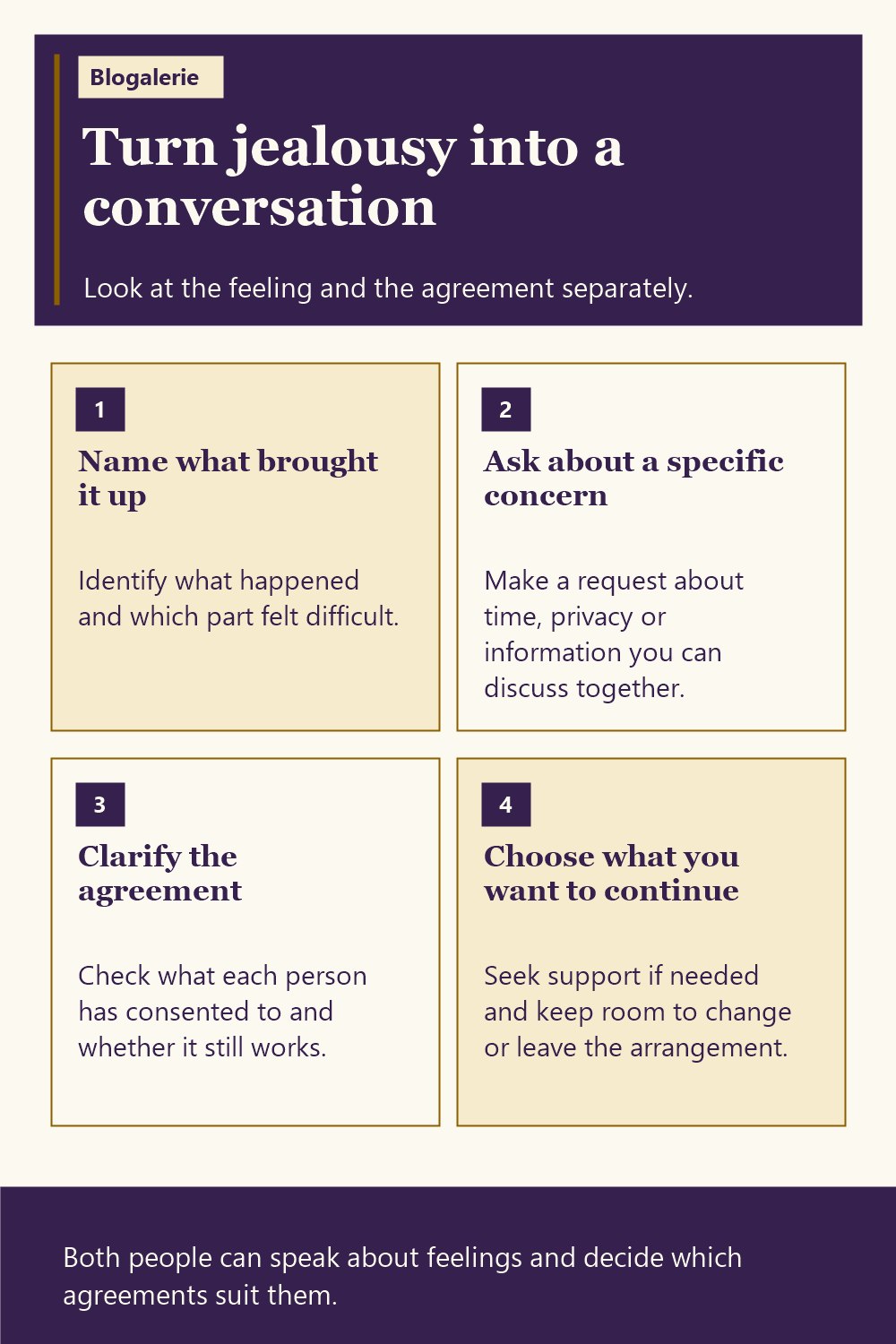
Read the infographic in text
Turn jealousy into a conversation Look at the feeling and the agreement separately.
- Name what brought it up Identify what happened and which part felt difficult.
- Ask about a specific concern Make a request about time, privacy or information you can discuss together.
- Clarify the agreement Check what each person has consented to and whether it still works.
- Choose what you want to continue Seek support if needed and keep room to change or leave the arrangement.
Both people can speak about feelings and decide which agreements suit them.
‘I find it compelling how cultural narratives shape our perceptions of love.’ The article suggests that acceptance plays a crucial role in overcoming jealousy; however, what remains unexplored are the psychological implications when one partner cannot accept such dynamics—does this reflect deeper issues at play?
‘Jealousy as a reaction within an open relationship context raises pertinent questions about human attachment styles.’ This article effectively illustrates that while some individuals might thrive under such circumstances, others may struggle significantly due to inherent emotional predispositions or past experiences influencing their perceptions of loyalty and love.
‘Open relationships’ provoke varying societal reactions and highlight our evolving understandings of intimacy and commitment. This article aptly outlines both the potential benefits and pitfalls associated with such arrangements, particularly focusing on the pervasive influence of jealousy. It would be prudent for individuals considering this lifestyle choice to engage in extensive discussions about their values and expectations upfront—this can significantly mitigate misunderstandings later on.
‘Navigating emotions like jealousy can be particularly challenging within non-traditional relationship structures.’ The points made regarding establishing rules resonate deeply; however, it could be beneficial if future discussions expand upon coping mechanisms that individuals have found effective beyond mere communication strategies.
The discourse surrounding open relationships often invokes a myriad of emotional responses, particularly concerning jealousy. It is intriguing to consider how the social constructs of love and fidelity are challenged in these contexts. Individuals who embrace open relationships may possess an inherent understanding of their emotional boundaries, yet this does not negate the potential for jealousy to manifest. The article rightly emphasizes the necessity of establishing clear ground rules, which I believe serves as a foundation for mitigating feelings of insecurity. Exploring how different individuals navigate these dynamics could further illuminate the complexities involved in such arrangements.
I agree with your perspective on establishing boundaries in open relationships. It is indeed a nuanced topic that deserves deeper exploration. Jealousy can serve as both a catalyst for personal growth and a barrier to relationship satisfaction, depending on how it is managed by the partners involved.
The notion that open relationships can be liberating is often counterbalanced by the emotions they evoke, particularly jealousy. The author’s insights into managing this emotion through communication resonate well with those who may find themselves in similar situations. I find it fascinating how jealousy can lead not only to conflict but also to introspection about one’s own feelings of self-worth and security within a relationship framework. This duality makes it essential for individuals to engage in honest dialogues with their partners to foster understanding and mutual respect.
While I appreciate your insights on communication, I wonder if some people may be inherently less suited for open relationships due to personality traits that make them more prone to jealousy.
Your analysis raises an important point about self-reflection in these scenarios. One cannot overlook how personal insecurities play into feelings of jealousy, especially when multiple partners are involved.