

A friend’s new relationship, another close friendship or a change in their routine can leave you feeling less certain of your place. You might miss time together, compare yourself with someone else or worry that the friendship matters less to them.
Give the feeling some attention without treating it as a verdict on you or your friend. Begin with what has changed, what you know and the kind of connection you would like to ask for.
On this page
Describe the moment that hurt
Try to name an event: a plan was cancelled, you heard about a gathering afterwards or a familiar weekly conversation has stopped. A specific description gives you more to work with than “I have been replaced.”
Ask what you miss. It might be companionship, being included in a particular activity, reliable plans or having someone ask how you are. You can want those things without expecting to be the only important person in your friend’s life.
If you are upset, give yourself time before sending a message or posting about it. You can write privately, speak with a trusted person or choose an ordinary activity while you decide what needs a conversation.

Separate events from assumptions
What did you observe, and what meaning have you given it? Seeing a photograph of your friend with someone else does not tell you everything about the occasion or their feelings towards you.
The NHS guidance on relationships and wellbeing suggests distinguishing facts from interpretations during a conflict. Try leaving a question open until you have enough information to ask about it.
You do not have to dismiss a pattern that is affecting you. Repeated cancelled arrangements deserve a different conversation from one delayed reply. Keep your concern tied to the pattern you can describe.
Ask for the connection you miss
Choose a private moment and a request your friend can understand. You might say:
“I’ve missed spending time with you. Would you like to plan a walk or a call next week?”
If a particular event hurt, describe it without deciding their motive: “When our plans were cancelled twice, I felt disappointed. Is there a different time or kind of plan that would work better?”
Listen to what is practical for them as well. A new job, relationship, illness or caring responsibility may change the time available. You can consider a different routine without pretending that you do not miss the old one.
Leave room for other relationships
Your friend can have other close connections, and you can too. Asking for time together is different from asking them to stop seeing someone, report every conversation or prove that you rank first.
If you feel an urge to test the friendship, pause before acting on it. Deliberately withholding contact to see whether they chase you may leave both people with less clear information than a direct request.
Respect privacy when you seek support. You can describe your own feelings without circulating screenshots, recruiting people to take sides or asking for updates about another person’s private life.
Care for your wider life
Consider what else offers company, interest or belonging. You might reconnect with another friend, return to an activity or choose a group you would like to try. There is no requirement to build a large social circle.
Keep the choice manageable and accessible. A familiar conversation or a short shared activity may be more useful than forcing yourself into an expensive or exhausting social plan.
If comparison keeps drawing you back to social media, consider muting an account or reducing repeated checking for a while. Choose a pause to support your own attention, rather than as a message your friend is expected to decode.
Notice how the friendship responds
A useful conversation may lead to clearer plans or a better understanding of the change. It may also show that the friendship currently offers less closeness than you want.
Notice whether care moves both ways and whether you can express a concern without ridicule. If you have hurt your friend while feeling jealous, acknowledge the specific action and consider a repair. Your feelings do not excuse controlling or humiliating someone.
You can keep a friendship with different expectations, ask for another conversation or give it more distance. You do not have to call yourself immature for wanting connection, or make someone else wrong for having a wider life.
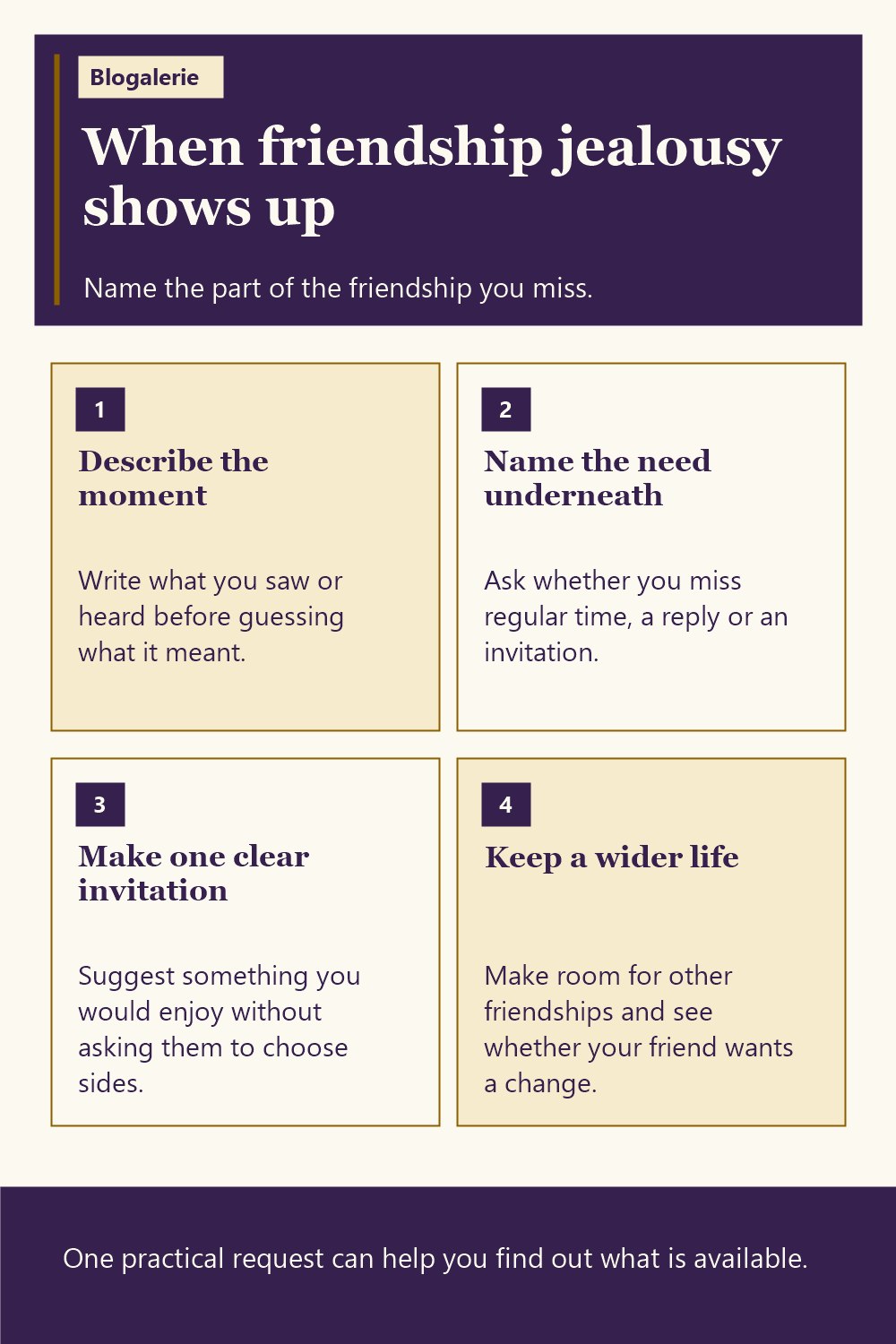
Read the infographic in text
When friendship jealousy shows up Name the part of the friendship you miss.
- Describe the moment Write what you saw or heard before guessing what it meant.
- Name the need underneath Ask whether you miss regular time, a reply or an invitation.
- Make one clear invitation Suggest something you would enjoy without asking them to choose sides.
- Keep a wider life Make room for other friendships and see whether your friend wants a change.
One practical request can help you find out what is available.
‘Fear of losing a BFF’ encapsulates one of life’s most profound dilemmas—the balancing act between love and fear in intimate friendships. The article does an admirable job discussing how understanding these emotions can lead us toward healthier relational foundations while simultaneously shining light on what truly matters: appreciation for those close to us.
‘Jealousy opens your eyes’—this phrase resonates deeply with me because it encapsulates the essence of human emotions acting as learning opportunities rather than mere obstacles to overcome. It’s interesting how the text explores both vulnerability and competitive instincts intertwined within friendship dynamics, providing food for thought regarding how we perceive our connections with others.
Jealousy is often perceived negatively; however, this article elucidates its potential benefits in personal growth and relational dynamics. The perspective that jealousy can highlight aspects of our personality needing attention is particularly compelling. It prompts us to question what insecurities are driving such feelings and encourages open communication with friends about these vulnerabilities. Such discussions could cultivate deeper connections rather than alienate individuals. Overall, the insights provided challenge the traditional view of jealousy as solely detrimental, suggesting instead that it may lead to meaningful introspection.
The idea that jealousy might enhance our self-awareness resonates strongly with me. In many ways, this emotion acts as a mirror reflecting our own insecurities back at us. Embracing this discomfort instead of fleeing from it could indeed be transformative for many individuals navigating complex interpersonal dynamics.
I completely agree with your analysis regarding the constructive aspects of jealousy in friendships. It’s fascinating how emotions typically deemed negative can actually serve a purpose in understanding ourselves better. Engaging openly with friends about feelings of jealousy could not only strengthen bonds but also pave the way for emotional maturity within relationships.
‘Jealousy reveals developmental insufficiencies’—this assertion caught my attention as it suggests that our emotional responses are inherently linked to personal growth trajectories. It prompts critical reflection on whether we use such feelings constructively or destructively within friendships and romantic relationships alike.
‘WisdomSeeker,’ your point about developmental insufficiencies resonates well within psychological frameworks surrounding attachment styles and personal growth narratives—certainly an area worth exploring further!
The commentary on friendship jealousy brings forth a vital discourse on emotional health within personal relationships. Jealousy serves not only as an indicator of attachment but also highlights areas where we may need reassurance or validation from our peers. Understanding this aspect could lead to more profound conversations about expectations and boundaries in friendships—elements crucial for nurturing healthy relationships over time.
The article presents a nuanced view of jealousy within friendships, highlighting its dual nature. On one hand, it can serve as a catalyst for self-improvement and reflection, while on the other, it can lead to destructive behaviors if left unchecked. This duality is something many individuals can relate to, as jealousy often stems from insecurity and fear of loss. I find it intriguing how the author emphasizes the importance of acknowledging these feelings rather than suppressing them. It raises questions about how we can better navigate our emotional responses in a way that fosters healthier relationships.