

Getting through a difficult period can involve adapting a plan, asking for help, resting or making a decision you would rather not have to make. You can do those things while feeling frightened, sad or uncertain. Resilience does not require a cheerful response to every setback.
If “mental strength” has started to sound like another standard you are failing to meet, consider a more useful question: what would help you handle the situation in front of you? The answer may include resources and support alongside habits you can practise yourself.
On this page
Understand the problem before pushing harder
Describe what has happened and what needs attention now. “The childcare arrangement changed, and I need cover for Tuesday” is a different problem from “I should be able to manage everything.” The first description gives you a practical starting point.
Separate facts, unanswered questions and predictions. You may know that a deadline has moved, need to clarify which tasks matter most and fear that asking a question will disappoint someone. Those are three different pieces of information.
Check whether the difficulty needs action, more information, a pause or immediate help. Persistence can be useful, but continuing with an unsafe or unworkable plan is not a test you need to pass.

Give feelings room without handing them every decision
Try naming a feeling in a specific way: “I am worried about the conversation,” or “I am disappointed that this did not work.” You can take the feeling seriously without treating every thought that comes with it as a fact.
If you have time before responding, use a pause in a way that suits you. Sit somewhere comfortable, have a drink, write down a question or speak with someone you trust. You do not have to complete a particular breathing or meditation exercise.
A pause does not need to make you calm before it counts. Its purpose may simply be to give you a little more room to choose what happens next.
Choose a next action you can recognise
Turn a broad demand into something concrete. Instead of “fix my career,” your next action might be to find the training requirements for one role. Instead of “sort out the disagreement,” it could be to ask when you can both talk without interruption.
Consider three questions:
- What needs attention first, and what can wait?
- What information or assistance is missing?
- What is a smaller version of the next step if my energy or time is limited?
Notice the effect of the action rather than whether it looks impressive. Asking one useful question may matter more than making a long plan you cannot currently use.
Use support that fits the need
Different problems need different kinds of help. A friend may offer company, a colleague may clarify a process and a relevant advice service may explain options. You can be specific about what would help: listening, practical assistance, information or someone to accompany you.
The NHS guidance on work-related stress includes identifying the source of pressure and discussing support or priorities. That distinction is useful beyond a single habit: coping with a demand and changing the demand are separate possibilities.
If a first request does not lead to useful help, consider another person or service. You do not have to tell everyone the details of a painful experience to deserve support.
Keep care in the plan
Look at the ordinary needs that have been squeezed out. Rest, food, following your existing care plan and time away from a demanding task can deserve space even when other responsibilities remain unfinished.
Choose what fits your health, mobility, budget and caring duties. An enjoyable activity can be brief or familiar. It does not need to improve your performance or become another daily target.
If your basic needs repeatedly cannot be met because the demands are too great, that is useful information about the situation. Consider what could be shared, reduced or supported rather than trying to become endlessly more tolerant of it.
Learn without forcing a positive lesson
After a setback, ask what you now know. Was the task larger than expected? Did an agreement need to be clearer? Was there a resource you did not have? Keep the review specific enough to guide a future choice.
If you made a mistake, acknowledge its effect and consider a repair. That can sit alongside recognising the effort you made or the constraints you faced.
You do not have to be grateful for harm or find a benefit in every loss. Some experiences call for grief, protection or professional support. Learning something later does not make what happened acceptable.
Know when to change direction
Reconsider a plan when the cost has changed, new information appears or continuing would work against your needs. A different route, a longer timescale or a decision to stop can be thoughtful choices.
If distress is persistent, worsening or interfering with daily life, a qualified health professional can help you explore support. Seeking help does not mean that you have failed to be resilient.
Choose one next step and one source of support that could make it easier. You can return to the larger decision when you have more information or more room to think.
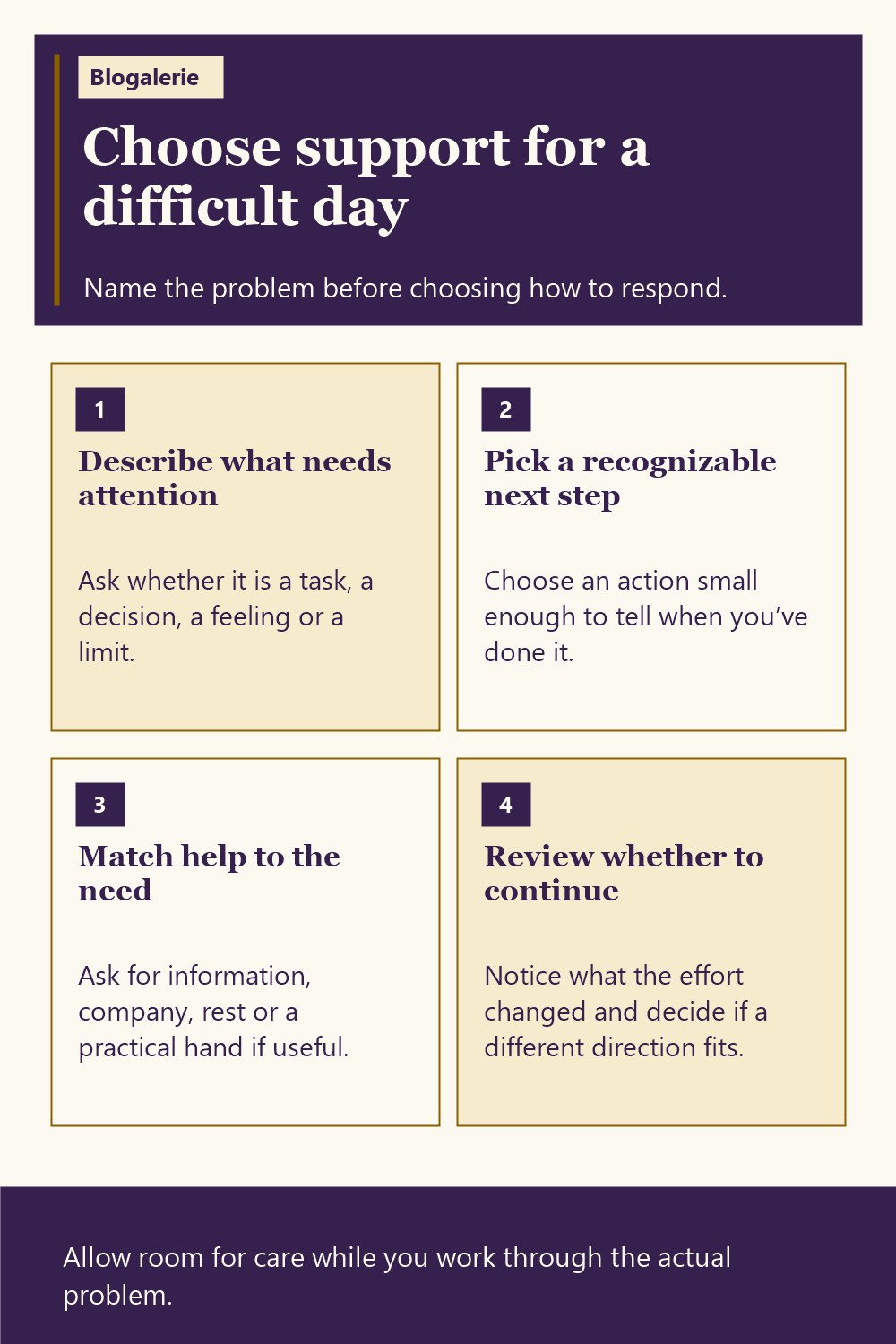
Read the infographic in text
Choose support for a difficult day Name the problem before choosing how to respond.
- Describe what needs attention Ask whether it is a task, a decision, a feeling or a limit.
- Pick a recognizable next step Choose an action small enough to tell when you’ve done it.
- Match help to the need Ask for information, company, rest or a practical hand if useful.
- Review whether to continue Notice what the effort changed and decide if a different direction fits.
Allow room for care while you work through the actual problem.
I find it fascinating how the article addresses the multifaceted nature of mental strength beyond mere willpower or motivation. The suggestion to ‘exercise your mind’ reflects an understanding that cognitive agility requires training akin to physical exercise. The advice to challenge oneself regularly aligns well with theories on neuroplasticity—whereby we reshape our brains through new experiences and learning opportunities. As someone interested in psychology, I wonder how much individual differences play a role in one’s ability to implement these strategies effectively.
The article provides valuable insights into developing mental strength through various techniques such as mindfulness and self-talk. It is interesting how these concepts intersect with emotional intelligence—a critical skill in both personal and professional settings. Moreover, the notion of viewing obstacles as opportunities encourages a growth mindset that many psychologists advocate for in therapeutic practices. It would be beneficial if future discussions included empirical studies that support these claims, thereby providing readers with evidence-based methods for enhancing their mental fortitude.
You raise an excellent point regarding empirical support, DataDriven. Incorporating research findings would lend credibility to the strategies mentioned and offer readers concrete examples of their efficacy in real-life situations. Additionally, I believe discussing the role of community support in building mental strength could enrich this conversation further—after all, our social environments significantly influence our resilience.
The article presents a comprehensive guide on building mental strength, which I find particularly relevant in today’s fast-paced world. Focusing on the moment seems to be a crucial aspect, as procrastination can lead to missed opportunities. Furthermore, the idea of embracing adversity resonates deeply; challenges can indeed serve as catalysts for growth. However, I wonder if there are specific strategies that might further enhance these principles, perhaps drawing from cognitive behavioral therapy or mindfulness practices? Overall, the emphasis on a proactive approach to mental resilience is commendable and essential for effective decision-making.
I appreciate your insights on cognitive behavioral strategies, CuriousMind. Integrating psychological theories into practical applications can significantly enhance our understanding of mental resilience. Moreover, the concept of self-talk is intriguing; how we communicate internally affects our external actions and outcomes. It’s fascinating how mental strength is not solely an inherent trait but rather a skill that can be cultivated over time through deliberate practice and reflection.
‘Respond positively’ stands out as one of the most actionable pieces of advice provided here; it emphasizes personal agency amidst uncontrollable circumstances. This resonates with my belief in proactive engagement rather than passive reaction when faced with adversity. The concept may also tie into existing frameworks within organizational behavior that highlight resilience as a pivotal trait for successful leadership during crises or challenging times.
Overall, this article serves not only as a guide but also acts as a reminder about the continuous journey toward enhancing one’s mental capacity over time through intentional practices like those outlined here—fostering greater awareness regarding emotions paired with disciplined approaches towards positive self-talk leads ultimately toward improved well-being long-term!
‘Mindfulness’ has been gaining traction as an essential tool for improving mental clarity and emotional regulation—it is commendable that this article highlights its importance alongside other approaches like gratitude and preparation for storms ahead. I am particularly intrigued by how cultivating gratefulness might transform one’s perspective on daily challenges into more manageable tasks rather than overwhelming obstacles.
‘Stumbling Toward Success’ encapsulates an important lesson about perseverance; indeed, many breakthroughs occur after repeated failures rather than immediate triumphs! Reflecting upon past setbacks can serve not only as motivation but also offers invaluable learning experiences that shape future endeavors—this notion should certainly encourage individuals who struggle with fear of failure.
The emphasis on ‘finding solutions’ instead of fixating on problems strikes me as critical advice applicable across various domains—be it business or personal life management strategies! In dynamic environments where adaptability is key, focusing energy toward constructive outcomes fosters innovation while simultaneously empowering individuals facing daunting hurdles.