

A friend called to tell me about a woman he felt deeply connected to. He was 60 and she was 30. He wanted to know how to make her want a relationship with him. I encouraged him to tell her how he felt and give her space to decide what she wanted.
On this page
Start with a choice both people can make
My friend described an ease in their conversations and a strong attraction. Those feelings gave him something honest to share. He could say, “I enjoy spending time with you and would like to go on a date. How do you feel?” A yes opens a conversation. If she declines, take her answer seriously and give her room.

Talk about the next few years
People at different ages can have compatible plans. Ask each other what you want around children, work, retirement, where to live and responsibilities for relatives. Ask how you would handle future caregiving or money decisions if the relationship became serious. Start with what each person wants today.
Notice how you make decisions together
Each partner should be able to disagree, set boundaries and keep friendships and independence. Pay attention to what happens when you have different needs or priorities. If one person has substantially more money or influence, talk about how to avoid turning that difference into control over where the other person lives, what they spend or who they see.
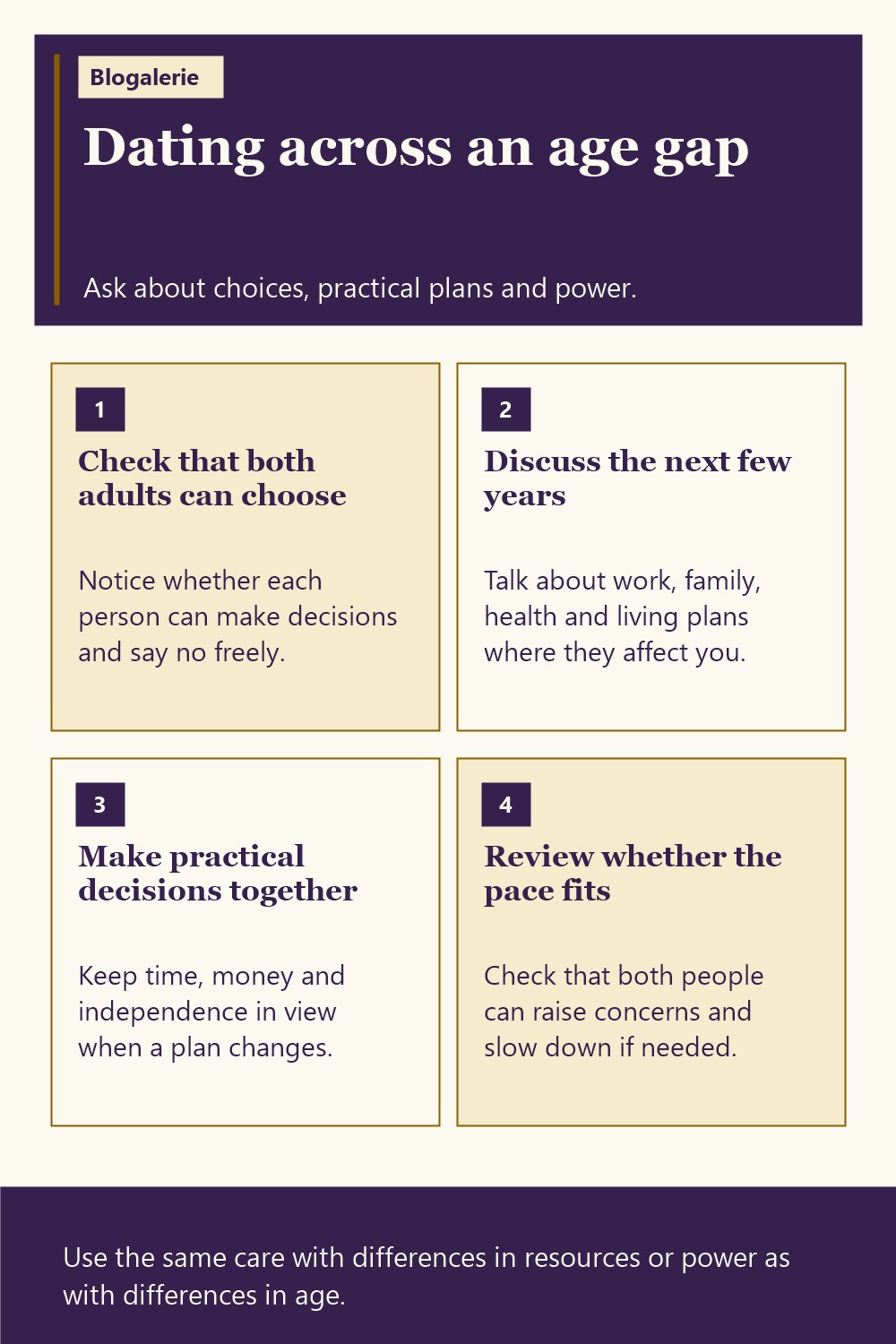
Read the infographic in text
Dating across an age gap Ask about choices, practical plans and power.
- Check that both adults can choose Notice whether each person can make decisions and say no freely.
- Discuss the next few years Talk about work, family, health and living plans where they affect you.
- Make practical decisions together Keep time, money and independence in view when a plan changes.
- Review whether the pace fits Check that both people can raise concerns and slow down if needed.
Use the same care with differences in resources or power as with differences in age.
The commentary surrounding transitory versus enduring relationship styles addresses a critical element—the role desire plays amid varying expectations across ages involved therein; however, there lies more beneath mere attraction itself than immediate gratification alone could convey; thus prompting further inquiry into long-term relational satisfaction derived from differing worldviews shaped by generational experiences.
“There’s beauty in learning from each other”—a sentiment echoed throughout this discourse on unconventional relationships. While I appreciate the exploration into honesty as a guiding principle within these frameworks, we must also confront underlying power dynamics associated with vast age discrepancies that can complicate genuine connection. Despite sharing experiential moments together, one must question whether unequal life stages inherently create imbalances detrimental to emotional stability long-term or if they merely reflect different priorities at various life phases.
“Power dynamics are indeed crucial; however, dismissing their potential benefits entirely might overlook transformative growth opportunities embedded within such unions.”
While I concur with many points made in this article regarding age-disparate relationships, it does seem overly simplistic to dismiss them as inherently flawed or unsustainable. Certainly, generational perspectives differ widely, yet it might be more constructive to analyze what each party brings into such arrangements rather than focusing solely on potential drawbacks. Additionally, one could argue that emotional maturity and life experience often play a more significant role than mere numerical age in fostering genuine connection. To label these unions as unviable overlooks countless successful examples that defy stereotypes and societal expectations.
In examining the complexities of relationships with significant age differences, it’s vital to consider both emotional and social factors at play. The author provides a candid assessment of how motivations can impact interpersonal dynamics, particularly in cases where one party may feel compelled to ‘sell’ themselves to another. I appreciate the emphasis on authenticity over manipulation; however, I believe there is merit in exploring why individuals find themselves attracted to partners from different generations. Such connections may challenge conventional wisdom but could also provide profound insights into human connection and shared experiences.
‘Seizing the moment’ is an evocative phrase that captures much of what is often left unsaid about fleeting connections between individuals from differing stages of life. This article brings attention to the notion that experiences hold intrinsic value regardless of their duration or outcome. However, should we not also deliberate on how such interactions might influence future choices? The idea that each person we meet has something meaningful to impart adds depth to our understanding of relationships at large—but it simultaneously begs questions surrounding emotional risk and vulnerability when engaging with significantly younger partners.
The narrative presented in this piece deftly encapsulates the tension between desire and practicality in relationships marked by substantial age gaps. The distinction drawn between transient connections versus long-term commitments raises intriguing questions about human interaction’s ephemeral nature. As one contemplates personal growth through shared experiences, one must also consider whether societal pressures unduly influence perceptions of legitimacy in these partnerships. It would be beneficial for future discussions to incorporate perspectives from individuals who have navigated similar waters—those who can provide firsthand accounts of navigating both joy and complexity inherent in such encounters.
“This article highlights an intriguing paradox: while cultural narratives may frame older-younger pairings as misaligned or precarious ventures fraught with tension over time’s passage, personal stories reveal nuanced realities often absent from generalized critiques on age differences.”
The article raises an interesting point about the dynamics of relationships across age gaps. It suggests that while emotional connections can be profound, practicality often governs long-term compatibility. The perspective offered highlights the importance of being honest about intentions and desires. However, I wonder if the author considers exceptions where age differences may not hinder relational satisfaction. Is it possible for such partnerships to thrive despite societal norms? Acknowledging personal growth within these experiences is essential, yet the potential for societal judgment cannot be ignored. This nuanced view of relationships invites a broader discussion on love’s various forms.