

If someone seems relaxed with friends but nervous around you, you may wonder whether he likes you. A change in behaviour can be noticeable, but it does not give you a reliable answer about attraction.
You can stay curious without analysing every movement. Focus on whether your interactions feel respectful, whether interest is mutual and whether a straightforward conversation would help.
On this page
Treat nervousness as an ambiguous sign
Fidgeting, looking away, speaking less or stumbling over words can happen in different situations. Someone may feel attracted, uncertain, uncomfortable or distracted. You may not know which explanation fits.
Comparing how a person behaves around you and around friends still leaves out context. Familiar company may feel different from a new conversation. A more relaxed interaction with someone else is not proof that they are uninterested in that person or interested in you.
Avoid using a list of body-language signs as a verdict. No single gesture requires you to pursue someone, and nervousness is not a substitute for agreement.
Look for respectful, mutual effort
Consider what the person actually communicates. Do they ask questions, listen, respond to invitations or suggest a plan of their own? Does their behaviour leave you comfortable expressing your preferences?
Those observations can help you decide whether you want to get to know them. They still do not guarantee a particular feeling or future relationship. A friendly conversation can be enjoyable without becoming romantic.
Pay attention to your experience as well. You do not have to become interested because someone might like you, or continue a conversation that feels uncomfortable.

Make conversation less pressured
If you want to talk, choose an ordinary shared topic and leave room for short answers. Ask one question, listen and allow the conversation to develop without demanding a performance.
You might mention an event you both attended or ask about an interest they have already shared. A quieter setting may suit you both better than trying to have a personal conversation in front of a group.
There is no need to point out, “You always get nervous around me.” Asking about their comfort can be simpler: “Is this a good time to talk?” If they seem reluctant, give them space.
Make an invitation clear and optional
If you would like a date, you can ask directly and kindly: “I’ve enjoyed talking with you. Would you like to have coffee sometime?” Let the question be an invitation they can accept or decline.
A clear answer and a mutually agreed plan provide more useful information than trying to decode a gesture. If the answer is vague, you can leave the invitation with them and continue with your own plans.
Choose a first meeting that feels comfortable and safe for you as well. Agree the place and timing together, and keep your ability to change your mind.
Respect a no, uncertainty or lack of interest
If someone declines, accept the answer without treating their nervousness as evidence that they secretly want to say yes. A quiet response or a smile does not reverse what they have said.
You can be disappointed and still stop asking. Trying to make someone jealous, arranging repeated accidental meetings or recruiting friends to persuade them adds pressure rather than clarity.
If you are unsure whether they understood an invitation, one brief clarification can be reasonable. After that, give them room to choose whether to respond.
Leave room for support without taking responsibility
You can be considerate without becoming responsible for making another person confident or comfortable enough to date. They can decide what they want to share and what support they need.
The NHS guide to social anxiety distinguishes occasional social worry from persistent fear that affects daily life. You cannot diagnose someone from a conversation or assume anxiety explains their behaviour.
If your own anxiety is distressing or affecting relationships and everyday activities, consider speaking with a healthcare professional. You can seek support for yourself while keeping your dating choices clear and unpressured.
You do not need certainty about every feeling before having a respectful conversation. Ask if you want to, listen to the answer and let mutual interest develop at a pace that works for both of you.
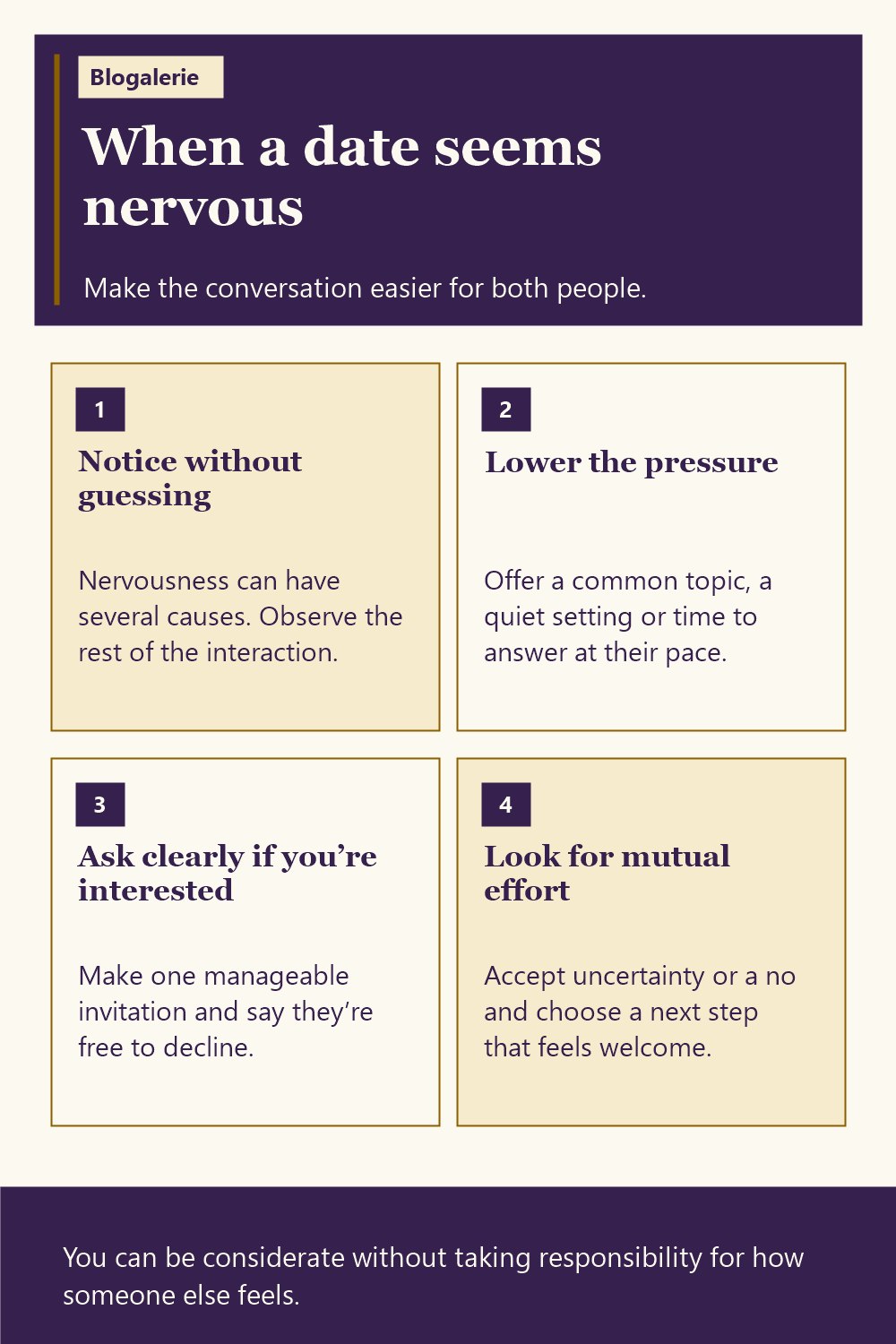
Read the infographic in text
When a date seems nervous Make the conversation easier for both people.
- Notice without guessing Nervousness can have several causes. Observe the rest of the interaction.
- Lower the pressure Offer a common topic, a quiet setting or time to answer at their pace.
- Ask clearly if you’re interested Make one manageable invitation and say they’re free to decline.
- Look for mutual effort Accept uncertainty or a no and choose a next step that feels welcome.
You can be considerate without taking responsibility for how someone else feels.
“Do I make you feel nervous?”—this suggestion encapsulates the essence of direct communication yet raises concerns about vulnerability involved in such inquiries. How does one navigate such intimate dialogues without risking discomfort or awkwardness? Encouraging open discussions about feelings can indeed foster deeper connections but might necessitate adept emotional intelligence and timing on both parties’ parts.
The notion that nervousness equates to attraction is quite thought-provoking. It posits a deeper psychological layer to social interactions, particularly in romantic contexts. This article encourages readers to analyze non-verbal cues and behavioral shifts, which can serve as critical indicators of interest. However, it raises questions about how societal norms shape our interpretations of these behaviors. Shouldn’t we consider cultural variations in expressions of attraction? A more nuanced examination could lead to richer discussions surrounding interpersonal communication and relationships.
“Embrace that you’re the one who controls your dating life” resonates strongly with contemporary views on agency within relationships. The empowerment narrative surrounding personal responsibility in dating choices is vital for fostering healthy connections; however, it’s equally essential not to overlook systemic factors—such as gender roles or societal pressures—that may constrain one’s perceived control over romantic pursuits.
While I appreciate the insights provided in this article, I find myself questioning the assumption that nervousness universally indicates attraction. Human behavior is inherently complex and influenced by numerous factors beyond mere romantic interest. For instance, a person’s past experiences or social anxiety might also play significant roles in how they interact with potential partners. Therefore, it seems prudent to approach such conclusions with caution and recognize that individual differences can significantly alter the dynamics at play.
You raise an important point about individual differences affecting interactions. It’s crucial not only to focus on general trends but also on personal backgrounds and experiences that shape behavior. Perhaps incorporating a wider range of perspectives could enhance our understanding of these interactions further.
Indeed, one should remain cautious with broad generalizations regarding human emotions and behaviors. While patterns may exist, each individual’s context varies greatly based on their unique histories and social environments.
The interplay between perceived confidence among peers versus vulnerability around potential romantic interests presents a fascinating study into human psychology and attraction principles at work here; however, my curiosity lies with how these patterns evolve over time within long-term relationships—is there a shift from nervousness towards openness once familiarity grows? Addressing this evolution could enrich discussions about relationship development comprehensively.
“Life is all about energy” is a compelling statement found within this text; however, it does beg the question—how do we measure or even define this energy? The idea suggests an almost metaphysical element at play during interpersonal exchanges. While I agree that energy can influence dynamics between individuals, quantifying such phenomena may prove challenging without empirical evidence or clear frameworks for analysis.
This article presents an interesting perspective on male behavior in social situations, particularly regarding the nervousness that can arise when a guy is attracted to someone. It highlights the importance of understanding the context of one’s actions, as nervousness may often be misinterpreted as disinterest. However, I wonder if this analysis could also apply to women in similar situations. Could it be that they too exhibit different behaviors around those they are attracted to? Exploring both sides of the equation might provide a more comprehensive understanding of dating dynamics.
“Laugh at his jokes” serves as an intriguing strategy for easing tension during initial interactions; however, humor can be subjective and context-dependent! It would be beneficial for readers to consider their own sense of humor alongside their partner’s preferences when attempting to establish rapport through laughter—it’s worth noting that what works for one pair may fall flat for another!